I crouch where the sandstone breaks into shallow shelves the color of old bone, one knee in dust, the other on loose grain that slides downhill with every shift of my weight.
The rock is so warm I imagine an ancient woman setting a kettle here and boiling water for tea.
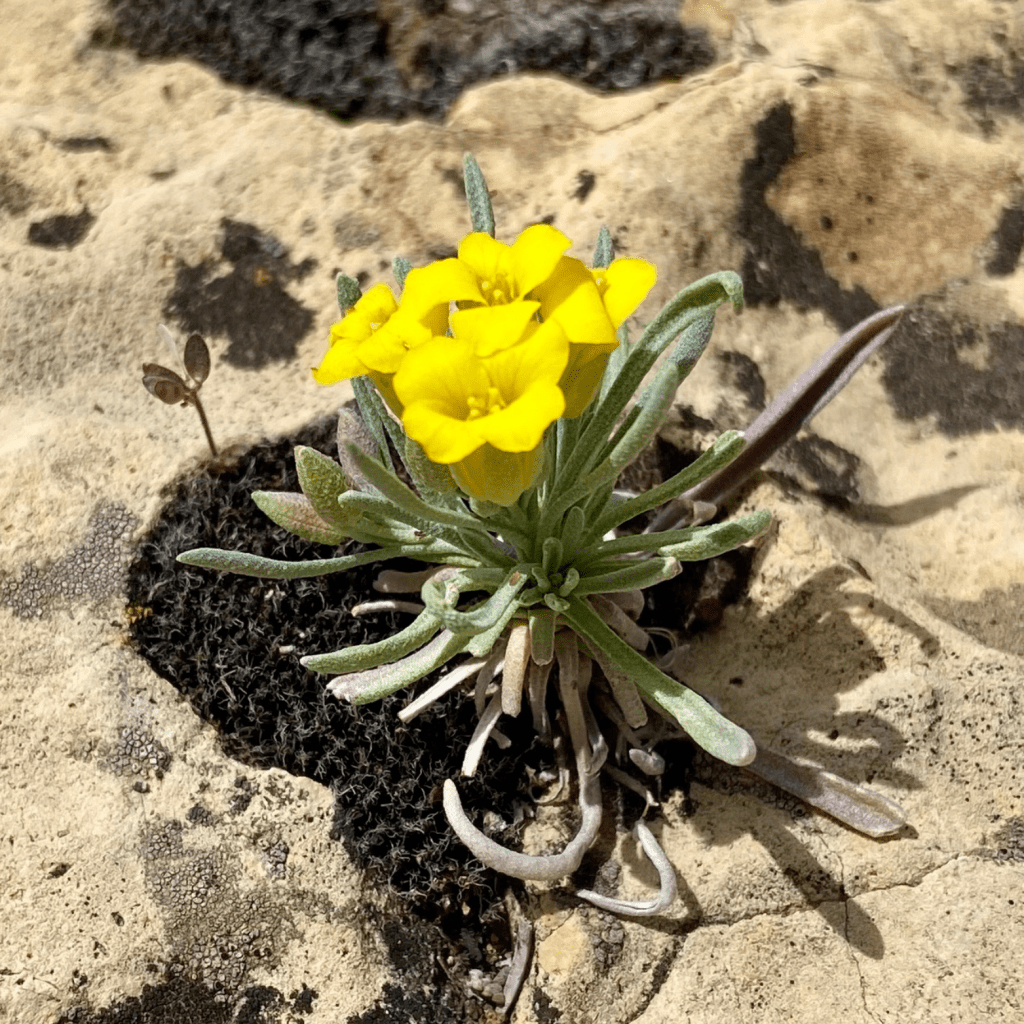
Emerging from the crevice—
yellow.
I admire the Painter through the painted and wonder at the Breath and the breath it takes to stay, in this place,
alive.
Four open cups lifting from a seam no wider than the edge of my thumb, petals folded back shamelessly in the morning light.
I lean so close I can smell the yellow. Or is that the bone? I've never smelled either so it's hard to say.
My hair falls forward and brushes the soil, one strand catching on a blade of green— I feel like an intruder,
slowly, hooking it behind my ear, then lower my face again— this time with more care— close enough to see grains of pollen caught in the folds, gold dust gathered at the center.
Treasure left out in the open.
A bee was here.
Maybe an hour ago. Maybe it's only been ten seconds.
How long do bees stay gone? Quickly,
I peer below the bloom. Silver leaves spiral outward in every direction, coated in tiny hairs that catch dust, light, and whatever the wind decides to leave behind.
I run one finger along the stem—
green at first, then red, then pale where the shadow begins and sunlight never quite made the turn.
I guess there are things even the sun never sees.
The stem narrows, twists once, then disappears into a seam too thin for my fingernail.
Still— there it goes.
Down through lime, through grit, through powdered shell, through pockets of black soil pressed deep between layers of stone older than language.
Roots no thicker than thread find water that probably does not splash.
I sit back on my heels, dust coating my jeans, my hand still warm from the rock, and watch one yellow cup
tilt upward another fraction toward the sun.
—Iris Lennox literary pen name of Jill Szoo Wilson
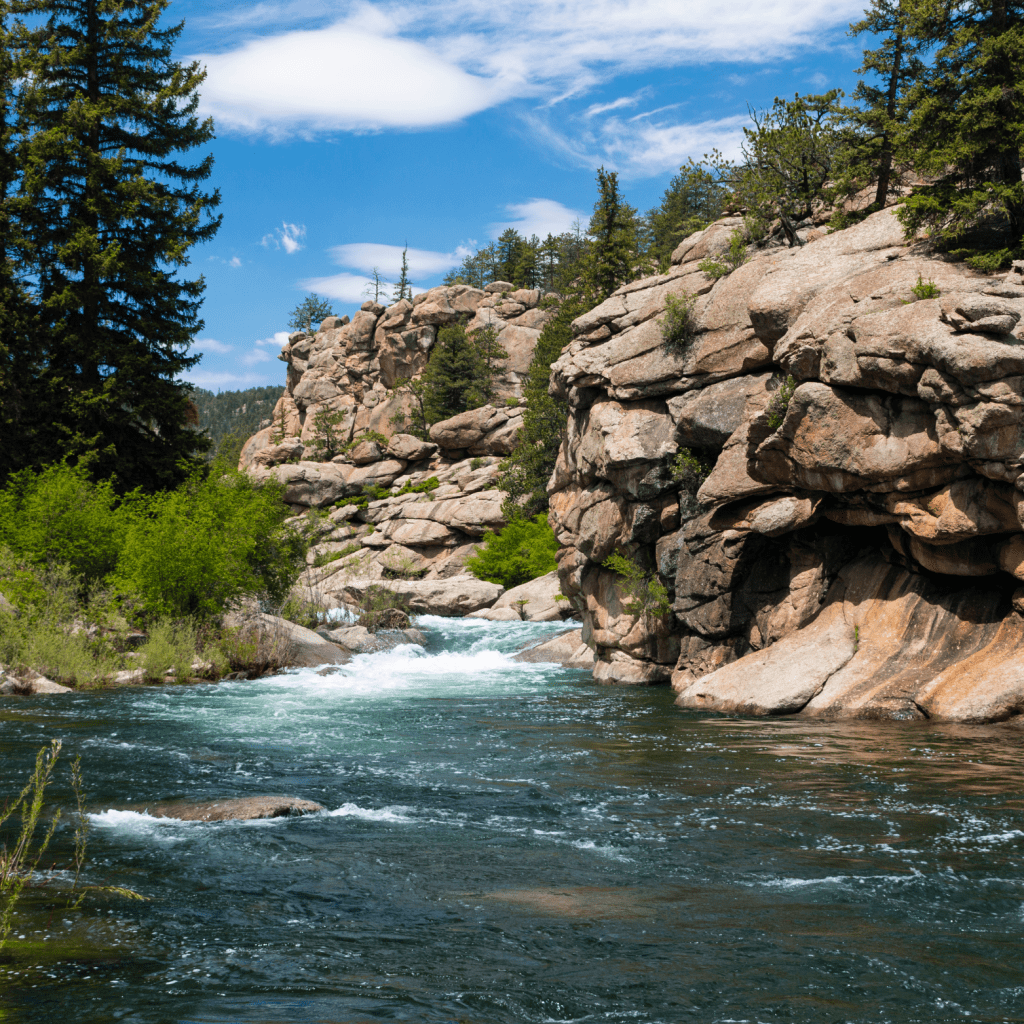
I sit on the splintered bench
where the trail drops close
to the river’s edge,
one boot untied,
laces dark from morning grass.

The wood pricks through my jeans
only when I swing my legs
so I have to choose between
comfort and carefree—
the mosquito zigzagging
around my wrist
reminds me to
slow down.

Below me, water folds over stone,
slides around a half-sunken branch,
catches for a second
on something I cannot see,
then keeps moving.

A world within a
world
within a
world.
Each with its own
beginning, middle, and
end.

I rest my elbows on my knees
and watch cottonwood seeds
land on the surface,
play Russian roulette
with the current and sometimes lose.

But sometimes they win.

There used to be an island here
but now
only swimming for fish
and food for one crane whose beak
was made for moments
like this.

Across the bank,
a sycamore leans like a dancer—
if I tried that move I might hurt myself.
But the sycamore—
graceful,
roots half exposed,
holding a wall of mud
through another season of rain.

What happens here at night?
Does the dancer feel lonely?

I run my thumb
along the groove
someone carved into the bench
years before I found it.
There used to be a heart
scribbled here.
Was it time
or circumstance
that rubbed it away?

Where do all the lovers go
who leave their hearts
on benches
in trees
and in one another's hands?

The river keeps carrying
branches, leaves, foam,
the occasional flash of silver,

and twenty feet downstream
a man in a fishing boat
has a pole for an arm,
a hat for eyes,
and a dream I cannot see—

I stay on the splintered bench
swinging my legs
watching the sunlight

feeling the shade.

—Iris Lennox
literary pen name of Jill Szoo Wilson
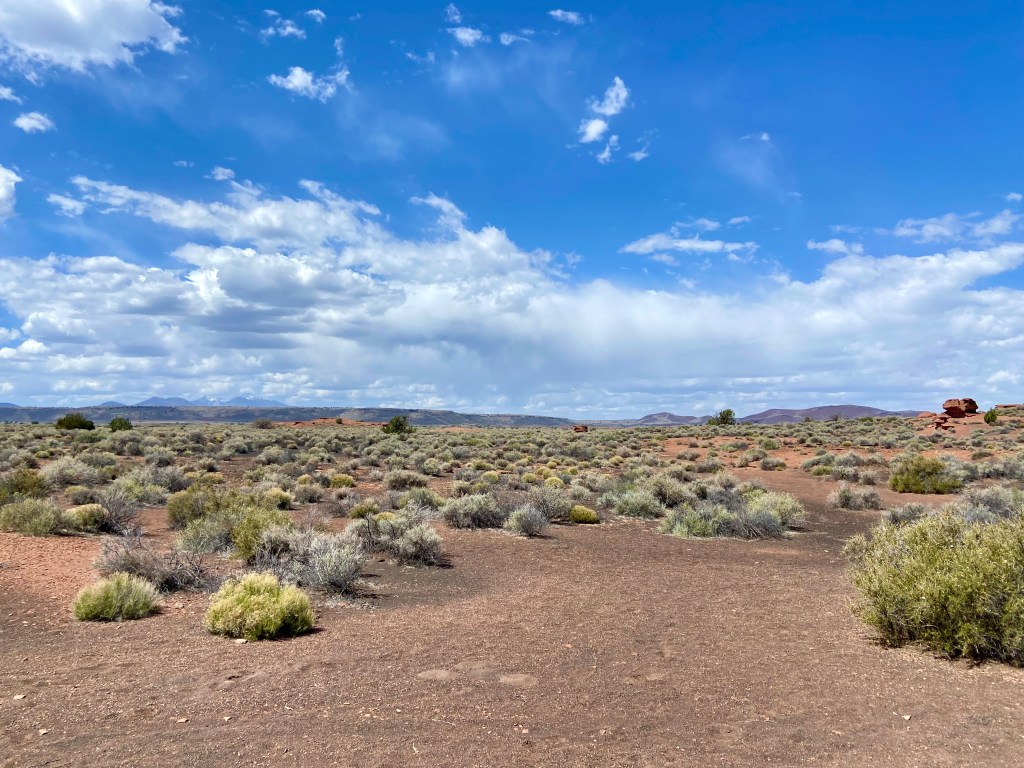
Morning lifts from the desert just before noon. I immediately regret each moment I missed— where was I when the sun rose here?
Light moves across basalt, sage, rabbitbrush, the red earth reflects warmth back into the blue.
Sunshine and earth, a love affair.
A strand of hair crosses my mouth and tickles my nose— as I swipe it away, I discover heat-burnished tenderness.
Sunshine, earth, and me— a love affair.
When I first arrived, I heard the crunch of my boots and all I brought with me. Water and ice sloshing against steel.
Also
half-finished conversations. A list. A sentence. A prayer, still wanting to know Him more.
Then the wind rises through the sage
and every branch answers.
Not all at once. Antiphonal. There must be a conductor here somewhere.
One stem, then another, then a hundred more clicking, brushing, rattling in no hurry to finish the song.
I have a feeling the song began at the beginning and will go on forever— it is a gift to hear this movement.
A Common Raven crosses low over the wash,
wings opening like someone who knows me and awaits my approach to the threshold.
Clearly, I am welcome here.
Higher still, a White-throated Swift not to be outdone cuts through the blue so quickly I hear the turn before I find the bird.
At my feet, a bee disappears into yellow rabbitbrush, comes out dusted, and goes right back in.
I'm proud of the bee and respect it enough to be a little scared, too.
Farther out, a Horned Lark drops three clean notes into the open country and flies off again. I'm struck by his boldness in speaking and not waiting— tell the truth, then let the echoes do the work.
Beauty and truth— companions from here to Kingdom come.
Even the grasshopper seems to understand.
Click. Up. Moving on. Trust.
And between all of it—
space.
Wide, sunlit, unoccupied space.
The kind that only exists here and anywhere there is desert. Around the globe but this one is mine, today.
I stand until my thoughts up. Click. Moving on. Standing still—
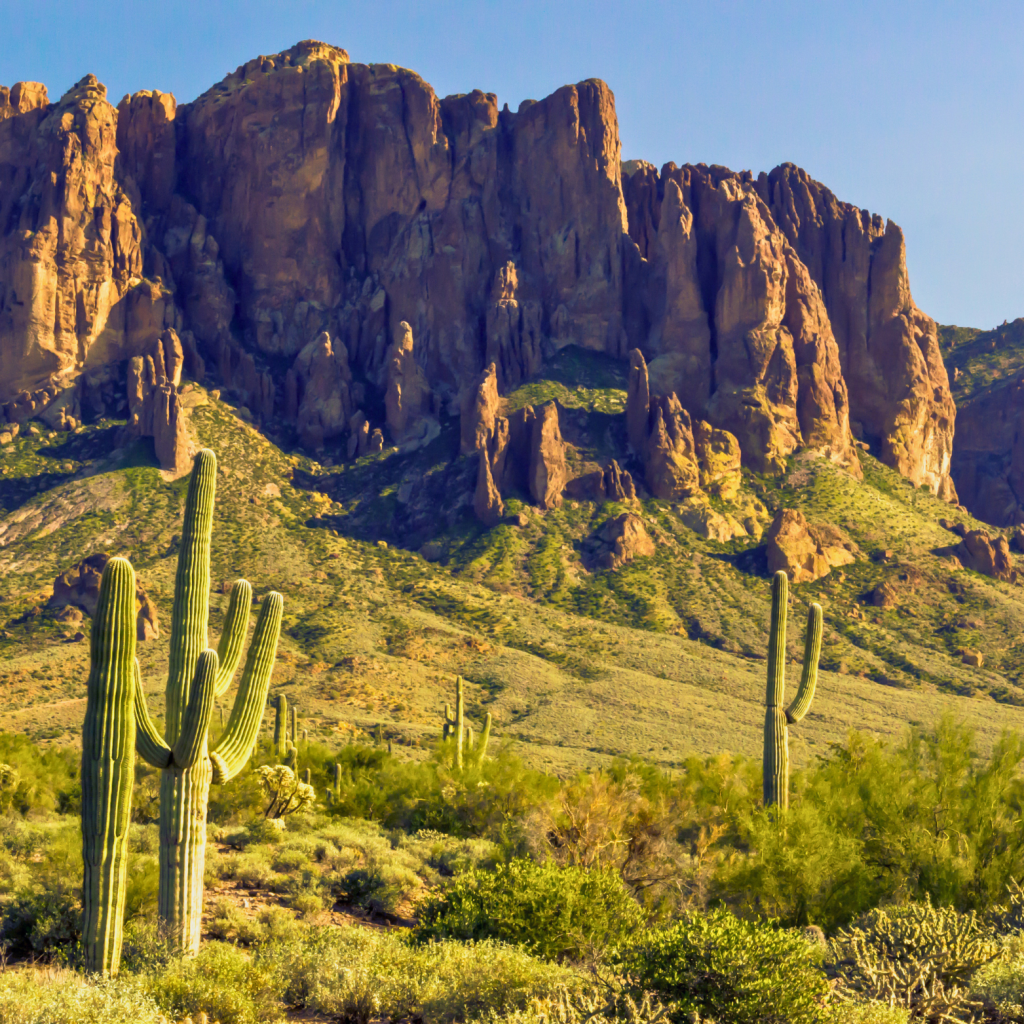
In a desert embrace between blue sky and sand, A lone cactus flourishes in a thirsty land. Her guardian spines, innocent and wise, Hold fast against winds she bravely defies.
Sandy soil enshrines roots running deep. Silent sentinels giggle while mimicking sleep— Toughened skin above, pulsing with might, Bold rebellion beneath the barbaric sunlight.
White blossoms bloom with delicate grace A coruscating crown in this desolate place. Petals unfold, poetry in hues, Through armored shroud, her beauty renews.
Survivor of drought and weather obscene, The cactus stands, a desert queen. In silence she writes mirage-soaked verses To a curious soul who nearby traverses.
“Dear cactus,” he ventures, “courageous and free, can you whisper your tales only to me?” She smiles coyly—she knows, but won’t tell— Accustomed to hellos, acquainted with farewells.
You might as well befriend the moon— embrace her clouded peekaboos. And music…
Receive the tune— no time to choose— alone in a crowd or no one in view. And a smell…
Wafts past your nose— what was that? Or who?
Perfume on skin or a place that you knew.
Pause.
No need to wonder— you know who that was— and who you are as nostalgia winds the second hand round.
“Time is a straight line,” said he. “It moves consecutively, watches as it goes behind and below, like walking a path that winds into— well— no one knows.”
“No one knows, that’s right,” said she. “Simply put, I do agree. But there’s no line to speak of. Time bends—not like a knee— more like a finger touching its thumb or a rainbow finding its spherical end and answering with a gentle, Come.”
Time returns to the places we’ve been.
One says, “That memory is far.” Another, “The moment is here.”
Yesterday can be set down, but the nows of that day rise from the ground without notice or sound—
to delight or confound— it depends on the seconds into which they were bound.
Moments become recollections. Recollections, seeds with a life of their own.
Promises and hope, gentleness and rage, a touch, a glance, a well-appointed room or a half-written page—
all sown into skin, finding rest in smiles and tears, repose and toil, love and loss, freedom and cost, and the way sunlight lay across the earth at the end or when it all began.
“That was back then,” said he. “That is today,” said she.
The minutes listened.
“There is wisdom in both.”
Time smiled— crouched, quiet— behind an autumn tree, waiting for the final leaf to fall.
It begins with a question as most things do— standing still and not understanding and then, why? Sometimes, how?
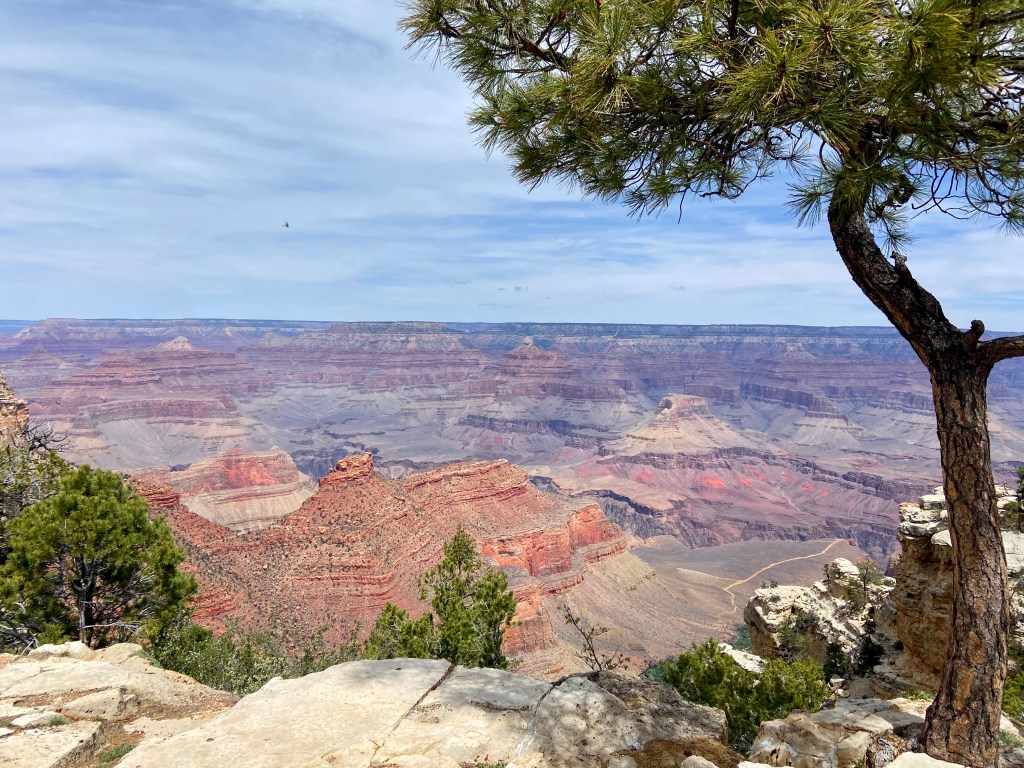
Before me— bands of color arranged with conviction, clearly the earth has already decided what each layer means and is in no hurry to explain itself.
The greatest beauty rarely does.
Someone wearing a mud-stained hat and pants that swoosh when he walks has named them. Kaibab Limestone at the rim. Toroweap beneath it. Coconino Sandstone—once dunes, moved grain by grain under a wind that no longer blows.
This was a desert, then a sea, then something in between that does not translate cleanly into a single word.
Mystery mingling with majesty.
I look at the red— Hermit Shale, perhaps— soft once, willing to be shaped, now holding its position like a memory that has settled into fact.
Further down, older still, Vishnu Schist— stone that endured heat, pressure, nothing erased, everything contained and displayed— a record I cannot read, written in a language I have not learned. But I recognize this:
Resilience.
Two billion years, give or take. The number means nothing to me other than "Wow."
The mind attempts a comparison— a human life, a century, a civilization rising and falling somewhere between two lines of rock.
It does not help.
Below it all, the river— still working. Still carrying what it has loosened. Still, rippling with stories that continue.
The Colorado meanders. It does not rush for anyone's benefit, the way an old man has learned to slow down. It cuts because that is what water does when given time and a way through.
I find myself asking questions that have no immediate use.
Who first noticed that this was once sand? Who looked closely enough to see ripple marks held in stone?
Who intuited that knowing this made the view larger and more intimate at the same time?
The tree beside me leans into its own inquiry, roots set in an answer that does not require words.
Its needles move in present tense.
No concern for uplift, erosion, continental drift— that long, slow negotiation between plates.
As for me—
I want to know how something becomes— how pressure instructs what to keep and what to release.
How absence— of water, of time, of witness— enters the record.
Curiosity does not simplify. It accumulates.
Another name. Another era. Another process quietly at work beneath the visible.
And suddenly the canyon is no longer wide.
It is specific.
I stand at the edge with a growing suspicion—
that beauty increases with knowledge,
and that time, unmeasured and indifferent, is not empty distance but the most patient artist I have ever encountered.
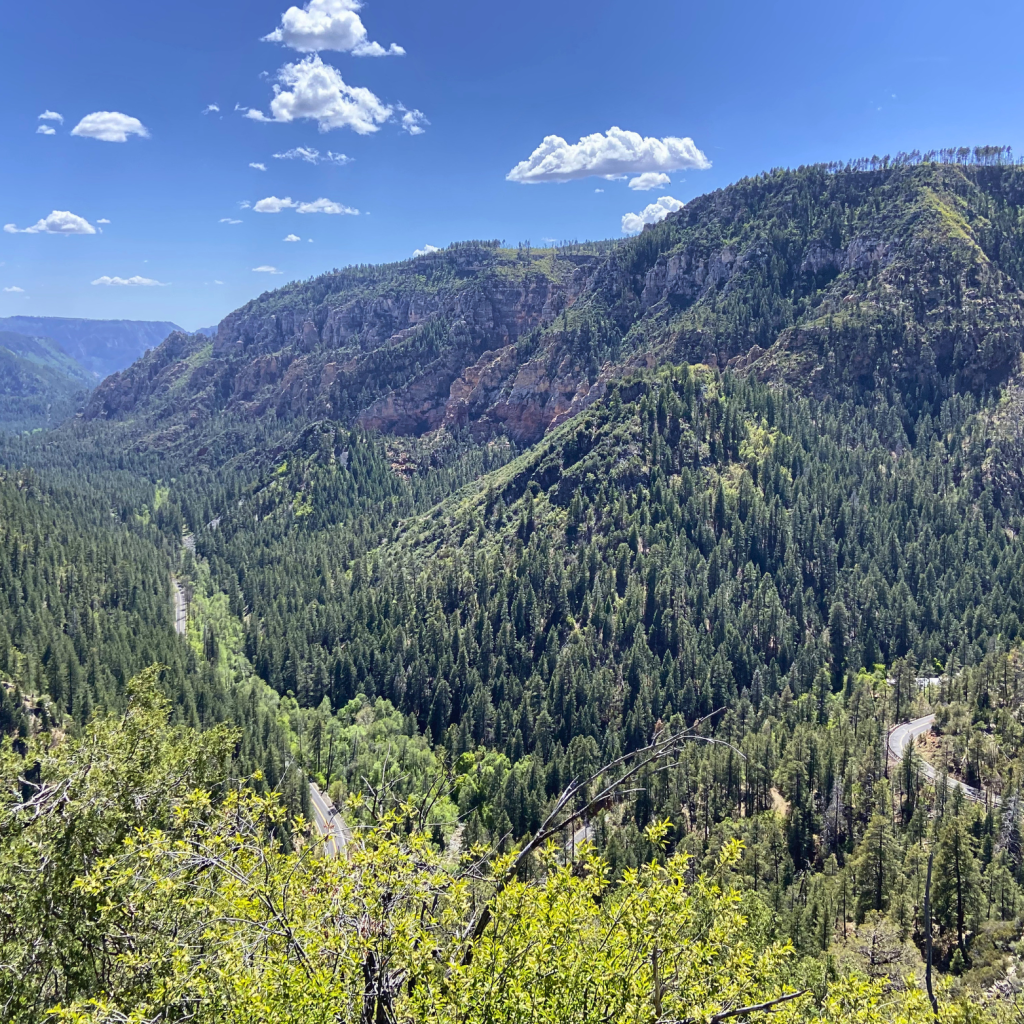
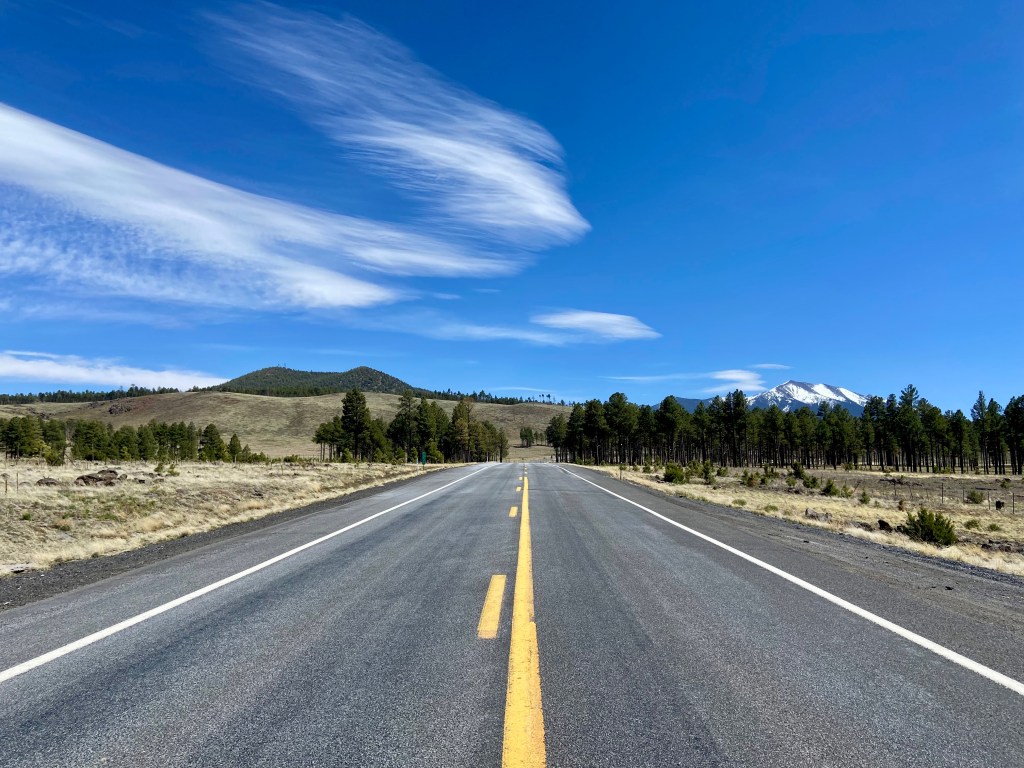
The road is empty, so naturally I walk to the center and stand on the line.
Silence but for the tapping of the cooling engine and the sound of waves— or maybe wind— blowing through pine needles.
Yellow lines under my feet— broken, then whole, then broken again, each piece looks like it's racing but I know better: resting.
Ahead, the road lifts.
Not much— just enough to take the next stretch out of view.
Driving, you don't notice how pretty the variation of black, gray, and blue after years of repaving.
You just keep going.
Inside the car you are listening, or talking, or thinking . . . anticipating, over the hill, onto the next stretch already laid out.
Standing here, the journey slows then stops.
Everything here knows one another and all is stable, but the wind and the clouds and the sun and moon and stars— but the road.
Each yellow line serves a purpose to guide to rightly divide . . . but also to watch to remember to enjoy?
It occurs to me in the middle of the road:
Trust in the Lord with all your heart, and do not lean on your own understanding. In all your ways acknowledge him, and he will make straight your paths.
No matter how fast or slow I move, God.
The road is the road.
The adventure— where I go— is up to You.
—Iris Lennox literary pen name of Jill Szoo Wilson
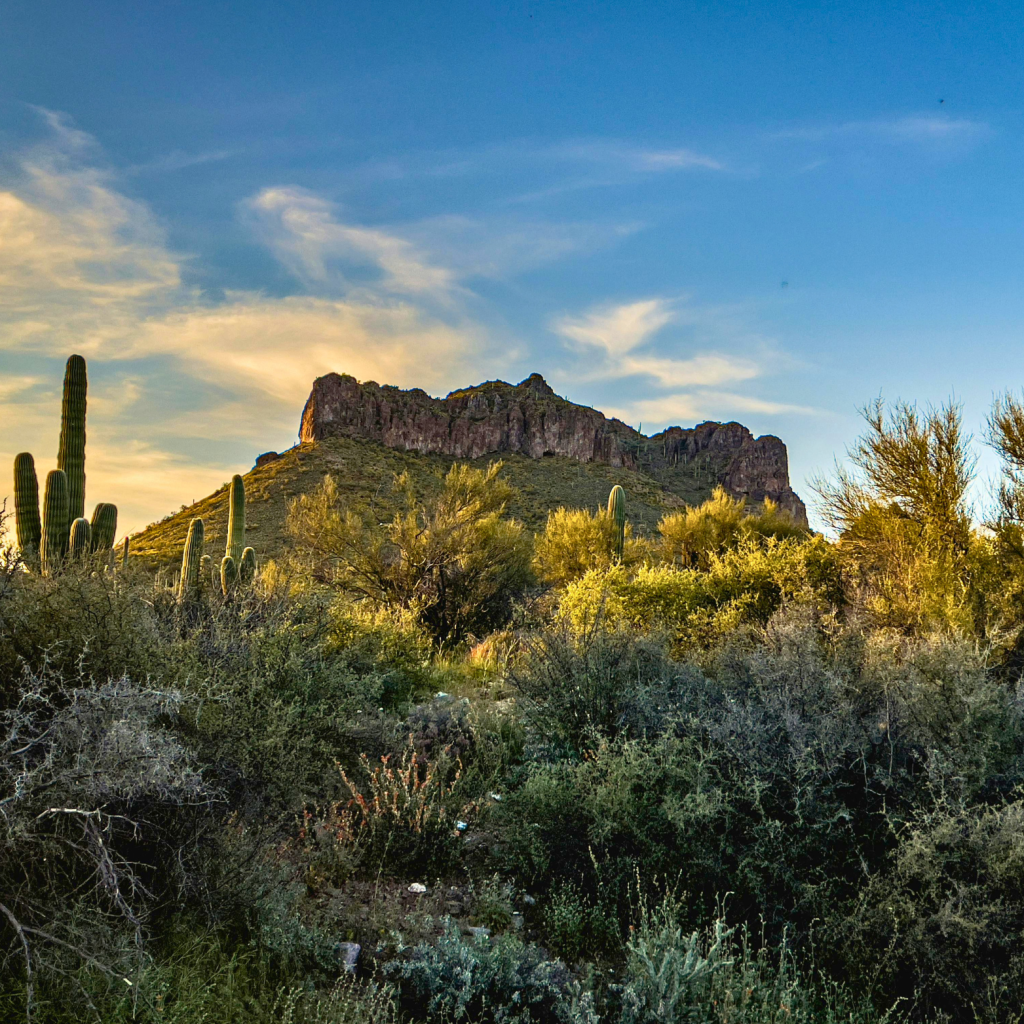
The photo is courtesy of Pixabay because my iPhone 12 didn’t quite cut it.
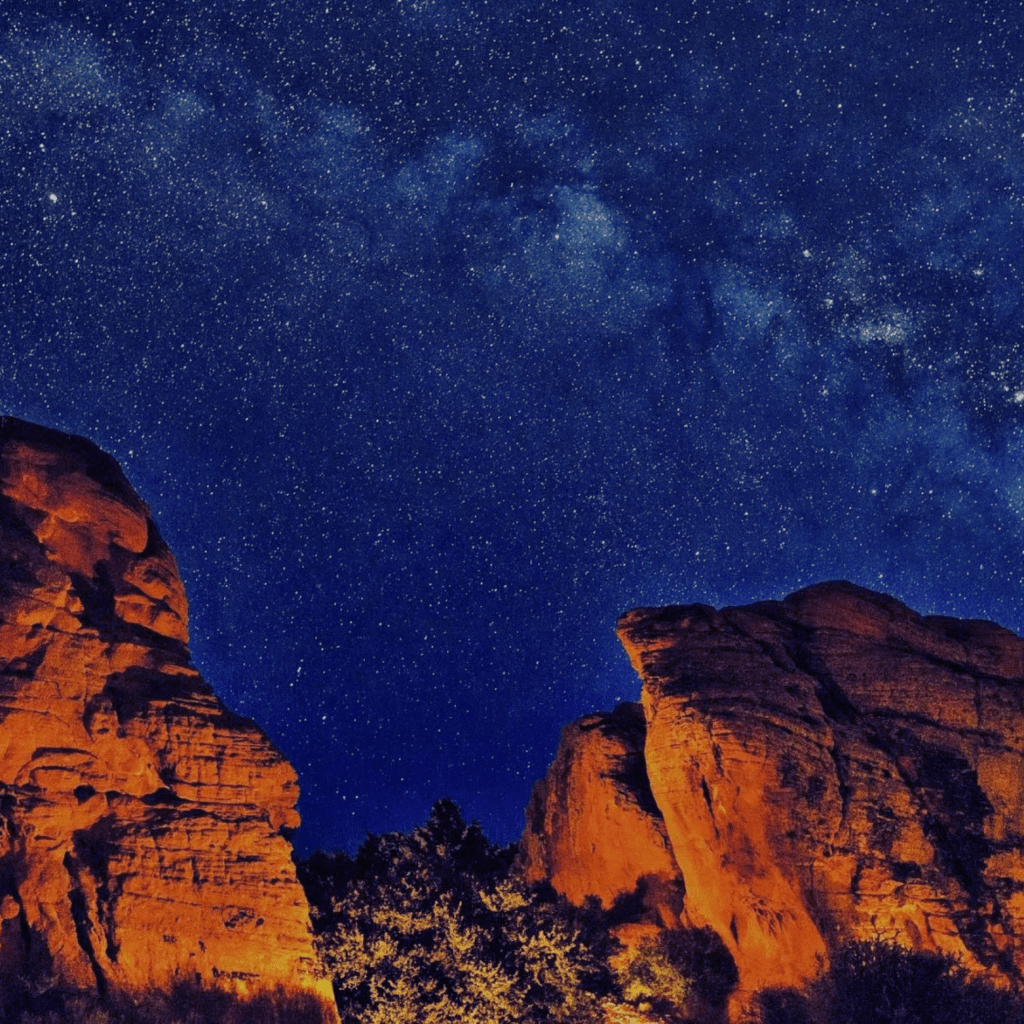
Night settles over the desert and the sky draws back like a curtain on opening night.
Stars peer from the wings and then enter from every direction— innumerable, but every one commanding attention.
I lay my head on my daypack no longer needed because . . . well, night . . . light arrives from distances I cannot measure, each point steady, each one burning fiercely but without sound.
Around me, the land falls into a hush that is greater than quiet— stillness.
Stone cools. Air thins. The last traces of what the sun gave rise from the ground and into the sky, probably trying to join in the celestial production.
Lucky.
Here we are in the chaos— for a time— but above, order.
Not scattered, not random, but placed.
Line after line, field after field, a vastness that neither moves toward me nor recedes.
Tightrope walkers, all of them. The theatre? Or a circus? None of my metaphors matter.
Every person stops— and you can understand why
why the eye lingers, why the body quiets, why the heart bends and breaks and mends and unfolds all in one inhale.
The sky doesn't look back. It doesn't need to. There is nothing we can give to it except wonder.
Brilliant, unreachable, unaffected.
And still— it draws.
The ground beneath me, the sky above me, the measure between them—
all set in order, all kept in place, all speaking without voice.
In the keeping of it, in the placing of each light and the distance between them, God gives:
what is set in the heavens and seen,
what fills the eye and commands attention—
and wonder— not as something given,
but as what rises in us at the sight of it,
returning, not to the sky above, but to the One who directs its course.