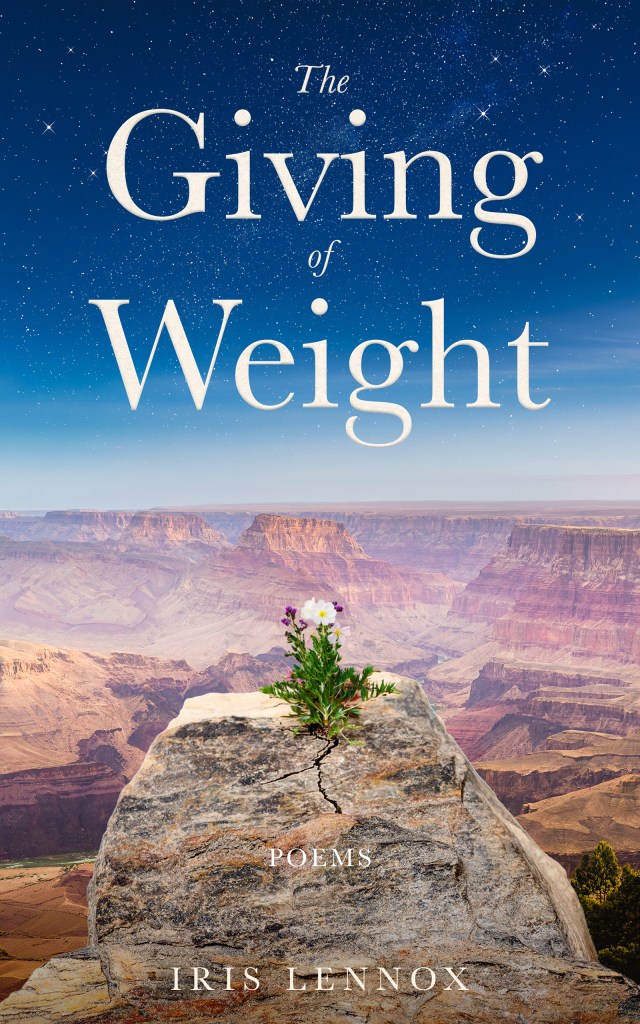
Life is mundane. On the edge of glory.
About the Collection
From the iron-rich dust of the Arizona desert to a splintered bench beside a Missouri river, The Giving of Weight explores the sacred hidden within ordinary life.
These poems begin in the physical world. A flower pushes through stone. Cottonwood seeds drift across moving water. A bruised voice discovers its strength beneath pressure. Yet the collection continually returns to a deeper conviction: that nothing is ever just one thing. Every landscape contains a memory. Every moment carries more meaning than first appears. Every life participates in stories larger than itself.
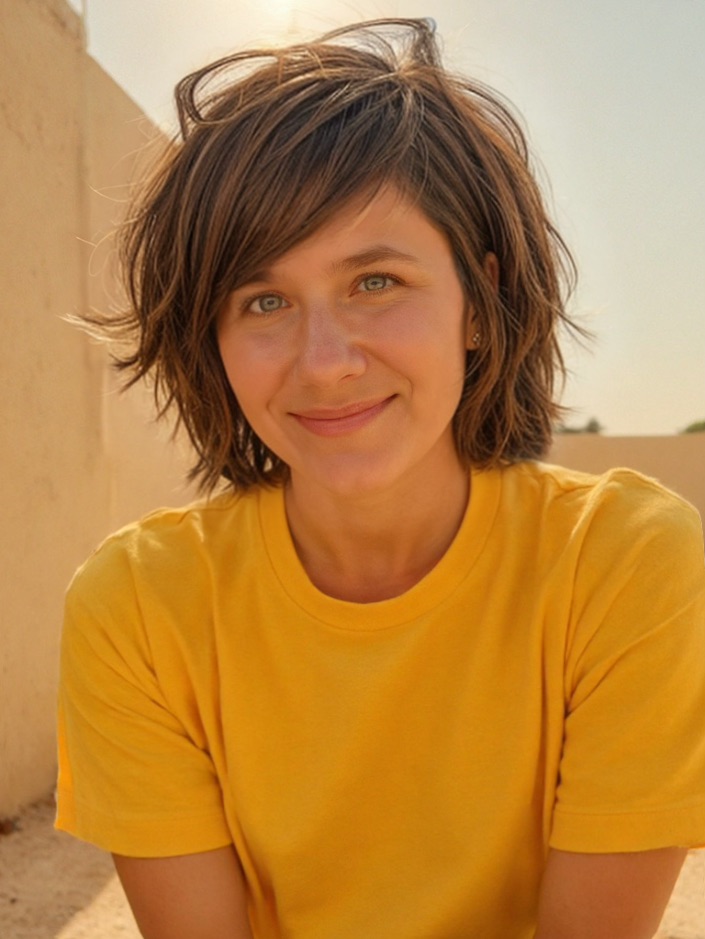
Writing as Iris Lennox, Jill Szoo Wilson pays close attention to the places where wonder and difficulty meet. The poems linger beside rivers, deserts, trails, and quiet rooms, searching for the connections that bind people to one another, to the earth beneath their feet, and to the One who created it all.
In a world that rewards speed and certainty, The Giving of Weight offers a different invitation. To slow down. To pay attention. To discover beauty, complexity, and grace hidden in plain sight.
From the Author
I’ve never been particularly interested in writing a book. Perhaps for the same reason I never wanted to be a full-time actor or director. I never wanted the thing I loved to become the thing I had to do.
Since high school, I have been able to spend hours writing when curiosity pulled me forward. The moment writing became an assignment, I felt pressure to be right. Sometimes even perfect. Over the years, my relationship with writing changed. I rarely think of it as writing anymore. I think of it as teaching. Or connecting. Or exploring a question I do not yet fully understand.
Years ago, I learned from Paul Simon that a piece of writing does not have to be the final word on anything. It can be an adventure. A question given shape. That is how these poems were written. I followed an image, a memory, a landscape, or a moment of wonder and paid attention to where it led.
Much of my work lives at the intersection of the vertical and the horizontal, where ordinary life brushes against something larger. I do not always know whether what I discover is right. I know only that it is genuine. At its best, writing becomes an act of attention and a form of praise to God, even when the subject itself is difficult, uncertain, or unresolved.
My hope is that this book sparks your curiosity.
Inside the Collection
Borrowed Earth
A flower pushes through stone. A river carries seeds downstream. Wonder begins with attention.
The Bruised Larynx
Poems of voice, grief, healing, and resilience.
The Wide Hush
Poems of peace, trust, time, and hope.
A Glimpse Inside
 Borrowed Earth

At the bathroom mirror
of a rented casita
somewhere in Flagstaff,
I discover
half the desert
came home with me.

Red dust
gathers along my collar,
settles into the seams
of my brown canvas backpack,
which used to be cream-colored,
and fills the tiny crease
above my sock line
where the trail
outsmarted me.

When I untie my boots,
sand pours
onto ceramic tile
in two soft cones.

The room suddenly feels
like a painting,
“Composition of Woman
and Borrowed Earth.”

Juniper pollen
clings to the cuffs
of my sleeves.

There’s grit
beneath my fingernails,
iron-rich and stubborn,
the color of old brick
after rain.

OPI might name it
Jazz Hands In the Desert.

I touch my scalp
and feel dust there too,
worked deep into my hair
through wind,
sweat,
sunlight,
and twelve miles
of canyon trail.

Good.

Today earned its right
to linger a little longer.

Some people
spend all day
trying not to stain themselves.

I understand the instinct.

There are white couches.
Important emails.
Polished shoes.
Entire industries
built around remaining untouched.

But somewhere between
mile four
and the moment
I sat directly on a warm rock
without checking
for dust,
my body remembered
something older
than neatness.

Children know it first.

Mud puddles.
Finger paint.
Grass stains.

At one point
I crouched low
to photograph
a cluster of desert marigolds
forcing themselves
through fractured stone.

When I stood again,
one palm carried sap,
and a line of sweat
ran slowly
from my neck
down the center
of my spine.

Perfect.

By late afternoon,
my shoulders glowed pink,
my lips tasted faintly
of salt and sunscreen,
and every object
inside my backpack
had acquired
the thin orange film
of Arizona.

Even the map.

Especially the map.

I ate trail mix
with dusty fingers
and decided
the extra crunch
only improved it.

Somewhere near the ridge,
a woman passing me said,
“Beautiful day.”

Then both of us
kept walking
without needing
to improve
upon the sentence.

There's nothing important
to say
out there.
Beauty speaks
and we simply listen.

And feel.
And I'm convinced—

The body experiences
some landscapes
on a cellular level.

Scientists eventually
gave the phenomenon
a long Latin name
after discovering
certain microorganisms
in the soil
can calm the nervous system.

Mycobacterium vaccae.
But I think we should call it
thereasonpeoplecry
when kneeling in the dirt.

Meanwhile,
every child
who ever came home
with muddy shoes
was already conducting
the experiment.

Back at the casita,
the sink runs briefly
orange-brown
when I wash my hands.

Dust circles the drain.

I pull one sock
inside out
and enough sand falls free
to start a small dune
beside the bathmat.

I hope my Airbnb rating
doesn't take a hit.

The shower waits.

Still,
I linger a moment longer
in the mirror,
sun-tired,
windblown,
grinning slightly
at the woman
standing there
with desert
still gathered
in every visible place.

Tonight,
Arizona leaves slowly.

One grain at a time.

—Iris Lennox
 Iris Lennox