Tag: Female Poet

  • Hamilton Creek Bridge


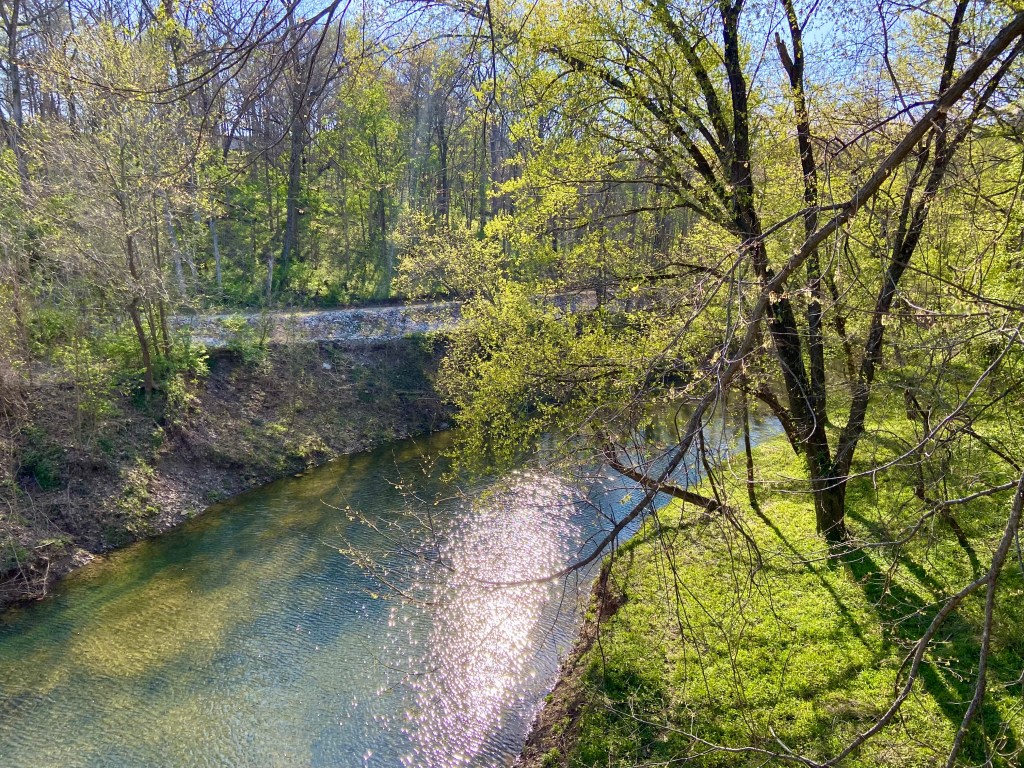
    Sunlight sparkling on Hamilton Creek beneath the Hamilton Creek Bridge near Wildwood, Missouri, with clear water, spring trees, and limestone banks.
    Inspired by Hamilton Creek in Wildwood, Missouri, “Hamilton Creek Bridge” is a contemporary nature poem by Iris Lennox about clear water, limestone, and the quiet forces that shape the landscape over time.

    I stop where cedar shadows fall
    across the weathered rail,
    and lean above the narrow draw
    where water threads the shale.

    It finds a seam the color
    of old bone beneath the moss,
    then slips between the sleeping stones
    without a splash or pause.

    The creek is scarcely wide enough
    to trouble any map.
    A branch lets go. A single leaf
    drops through the sunlight’s trap.

    It circles once in amber light,
    then catches in a bend
    where grains of sand, as bright as salt,
    begin their patient wend.

    Rain gathers breath from oak and fern
    before it finds this place.
    It turns faintly acid as it falls
    against the limestone face.

    Not all at once.
    One crystal first.
    One edge too small to see.
    A hollow deepens grain by grain
    beneath the sycamore tree.

    A swallow skims.
    The bridge holds still.
    The afternoon grows warm.
    Below, the water keeps its hand
    around the selfsame form.

    I watch it pass beneath my feet
    with neither haste nor sound,
    wearing through the living rock
    the way roots enter ground.

    —Iris Lennox

    Curious about the history of the nearby landscape? Read Zombie Road: The Story Beneath Missouri’s Most Haunted Trail, an essay about Rock Hollow, Lawler Ford Road and the landscape beneath one of Missouri’s most famous legends.

  • The Wren Comes Once a Year


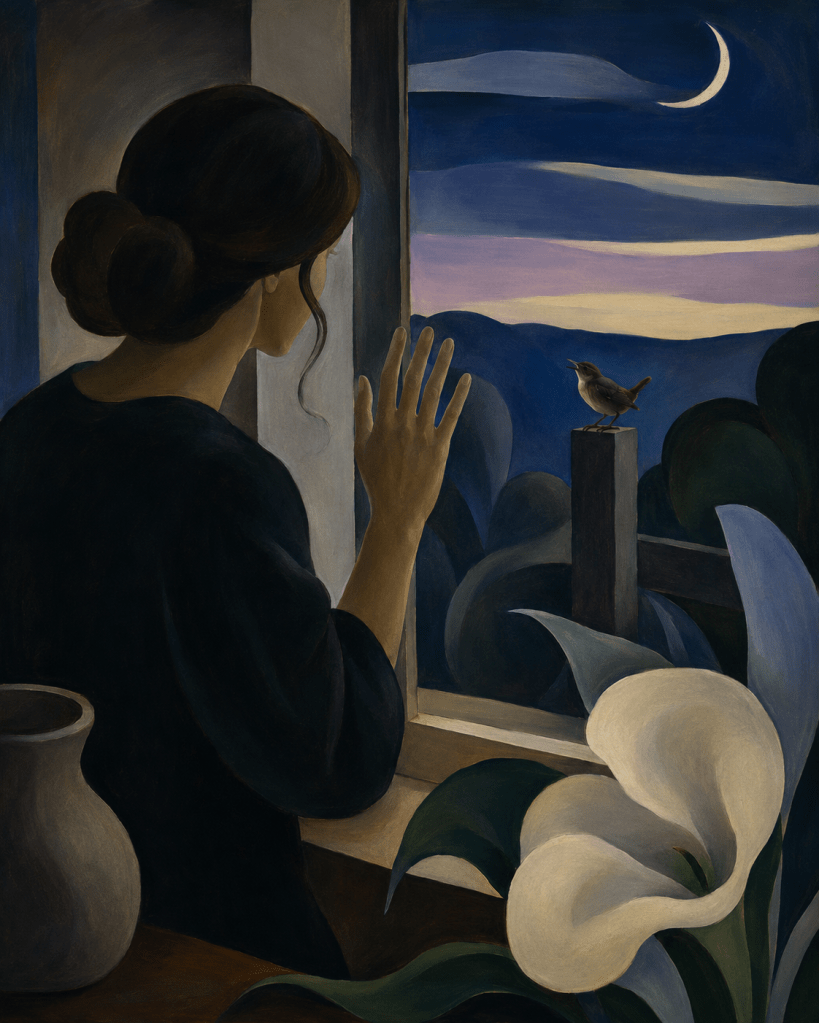
    The wren comes once a year to me,
    in July, toward the close of day,
    when heat still trembles in the trees
    and all the shadows stretch away.

    He chooses neither branch nor wire
    but lands upon the weathered gate,
    his little breast a pulse of fire,
    as if a bird could carry a date.

    I stand inside. I do not move.
    The glass is warm beneath my hand.
    He lifts his throat into the grove
    and sings what I don't understand.

    Last year, I wrote a lyric here
    when this same wren sang into night.
    Tomorrow lingered, soft and near,
    inside his handful of twilight.

    This year he comes. I write a poem.
    He tips his head and sings once more.
    I do not ask how he has known
    to find the same July-lit door.

    This year I keep the window closed.
    The curtain stirs against my wrist.
    Outside, the evening bends and folds;
    the hedge turns blue beneath the mist.

    The wren knows nothing of before.
    He doesn't count what I have kept.
    He sings beside the garden door
    where last year's fallen petals slept.

    Perhaps he came for no one here.
    Perhaps the gate was simply near.
    Perhaps a wren comes once a year.

    And still I wait until he's gone
    before I move or breathe again,
    while dusk collects across the lawn
    and one small branch remembers the wren.

    —Iris Lennox
  • Ghost Town


    Once home to more than two thousand people, Times Beach, Missouri, is now part of Route 66 State Park, its former streets winding through grass, wetlands, and trees.

    Grass grows high along the path,
    seed heads bending in the July heat.
    Cottonwoods lift their silver leaves
    and turn them over in the wind.

    Somewhere beyond the trees,
    the Meramec moves brown and slow.
    Cicadas start and stop.
    A turkey disappears into the sumac,
    leaving one branch shaking behind her.

    I walk where the path bends gently,
    following its long, deliberate curve
    through Queen Anne's lace and clover.

    For years, I've assumed the curve was shaped by the land.

    I think the trees have drawn it there,
    that roots and rain have persuaded the path
    to turn a little to the left.

    But the curve was here before the trees.

    This was a street.

    The slightly hidden marsh beside me
    had an address.
    There were mailboxes here,
    porch steps, garden hoses,
    bicycles dropped in yards at dinner time.

    A woman shakes a white sheet in the sun.
    A screen door strikes its frame.
    Someone calls a child home
    before dusk makes the river invisible.

    I hear no names being called.

    Still, I stand in the middle of the old road
    while cicadas stitch their noise through the trees,
    and for a moment the grass seems crowded.

    They sprayed the roads with oil
    to keep the dust from rising.

    The streets were unpaved then.
    Cars sent the dry earth climbing
    into open windows and onto porches,
    over laundry, into kitchens,
    into the mouths of children playing outside.

    So they paid a man to settle it.

    He came with a truck
    and spread oil over the roads,
    darkening the dust,
    pressing it back into the earth.

    Such a small sentence:

    to keep the dust down.

    To keep it from settling on windowsills,
    on supper plates,
    on the faded blue jeans drying in the sun.

    The road kept what it was given,
    accustomed to service.

    Eleven summers pass.
    Children ride bicycles over it.
    Rain darkens it.
    The sun warms it.
    Women open their windows in April.

    Then the river rises.

    It enters the houses without knocking,
    climbs the stairs,
    lifts chairs from kitchen floors,
    pulls photographs from drawers.

    And when the water folds back
    into its comfortable rhythm,
    it leaves the secret in the mud.

    I walk here now
    with sunlight brushing across my shoulders.

    No houses.
    No mailboxes.
    No white sheets rising in the wind.

    Only the wetland,
    the mound,
    the old roads curving through the trees.

    They burned the poisoned earth eventually,
    two hundred and sixty-five thousand tons of it,
    and buried what remained beneath the grass.

    I've walked the hill where fragments of a town
    turn slowly in the earth—

    a blue cup without its handle,
    one white button,
    the rusted hinge of a closet door,
    a marble lost beneath a child's bed,
    the broken mouth of a jar
    that once held peaches.

    Things someone touched every day
    without knowing there would come a day
    when no one touched them again.

    Now coneflowers open in the sun.
    Frogs call from the water.
    A red-winged blackbird bends a reed
    almost to the ground.

    I have walked here for three years
    without knowing what was under my feet.

    The streets, trails.
    The mound, a hill.

    I watched deer step out at dusk
    where someone's back door used to be.

    Today I stop beside the tall grass.

    The wind passes over it
    and every green blade leans
    in the same direction.

    Then rises.

    Then leans again.

    As if the earth is trying
    to remember a name.

    —Iris Lennox


    If you'd like to know more about the town beneath these trails, I wrote about the strange history of Times Beach and its second life as Route 66 State Park here.

  • Nearly


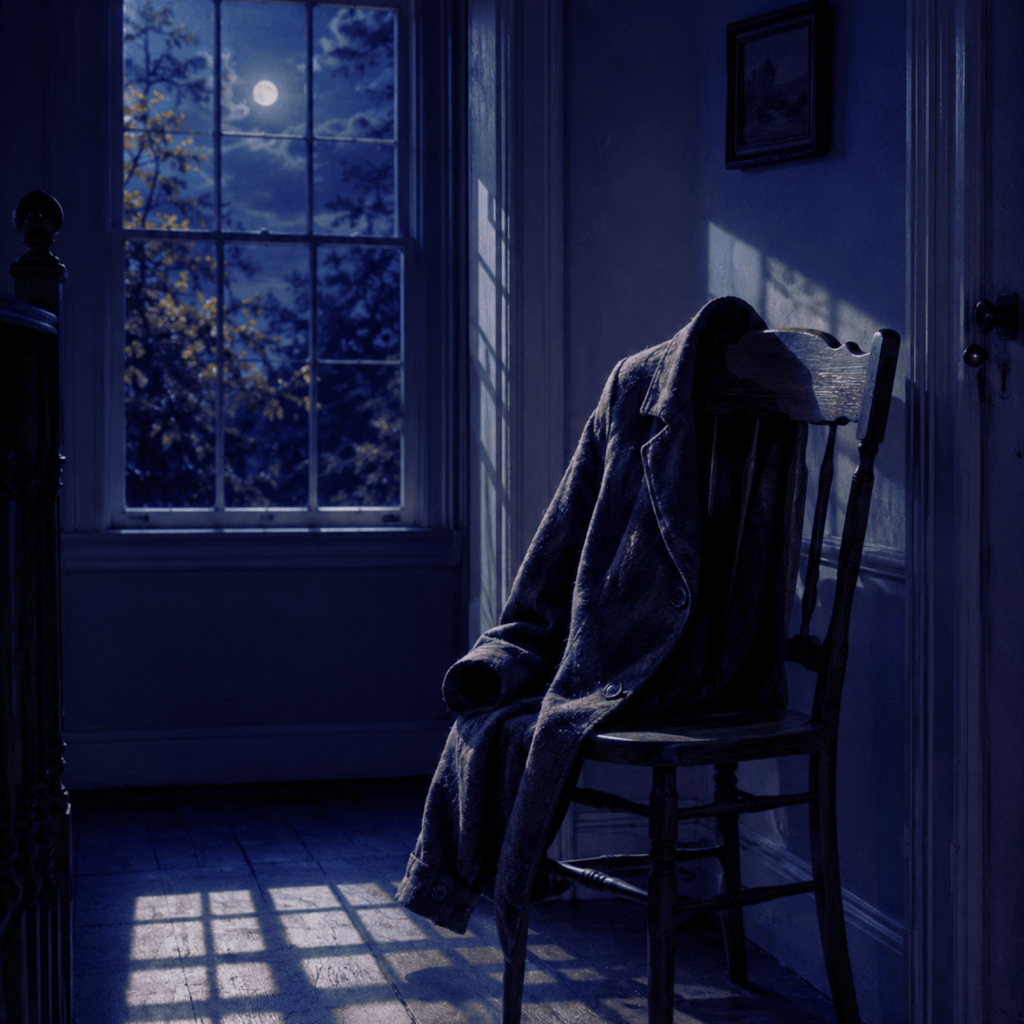
    At half past two I cross the hall
    to fetch the book I left downstairs.
    The moon has laid a silver shawl
    across the floor, the walls, the chairs.

    And there you are.

    No—

    just my coat
    thrown on the chair the night before,
    one empty sleeve beside the oak,
    one shoulder leaning toward the door.

    The pipes knock twice behind the wall.
    Outside, the maple shakes its hood.
    A branch lets go. I hear it fall.
    I stay there longer than I should.

    The coat is mine. I know its weight.
    I know the tear beneath one arm.
    I know each button, cuff, and seam—
    yet cloth, for one breath, can feel warm.

    Still, something in the way it leans
    against the chair's familiar frame—
    the folded cloth, the empty sleeve—
    has nearly said a name.

    Nearly is a troublesome word.

    A letter nearly sent may wait
    inside a drawer, unseen, unread—
    but still, before it meets its fate,
    it knows the truth that wasn't said.

    Nearly home.
    Nearly forgotten.
    Nearly enough.

    I lift the coat to put away,
    inside the closet by the stairs.

    One hand finds mine inside the sleeve.
    I turn once slowly through the air.
    For one small moment, I believe—

    Its buttons touch my wrist.
    One empty arm rests against my own,
    and the smell of cologne
    nearly
    brushes my cheek.

    In the window,
    the glass reflects one of us.

    Wait—

    for one turn,
    perhaps two.

    So I turn once more.

    Then I return it where it lay,
    one cuff still folded toward the floor.
    The shadows gather where they may
    and leave me standing as before.

    The window holds its square of sky.
    The pipes have all gone quiet now.
    The moon still silvers every wall.

    I reach for the railing.

    Behind me,
    the coat lets go.

    I hear it fall.

    —Iris Lennox
  • Three Measures of Light


    I’ve taken a short break from writing poetry. But I’m back now. I’ve been in a liminal space between the exhale of one season and the first inhale of the next, letting the light change as the season does, too. That’s what this poem is about.


    Behind a heavy red curtain,
    I press one finger into the velvet
    where someone has patched it with black thread.

    How many performances has this curtain seen?
    Who stood here, beneath the work light,
    needle between two fingers,
    pulling the torn edges toward each other?

    Torn edges are a sign of some previous life
    on the tips of leaves and petals,
    and on curtains.

    The repair is sturdy.
    Still, dust forms in a shock of light
    where the two halves almost meet.

    A man dressed in black sweeps the stage
    and leaves one silver staple near the leg of a chair.
    Maybe he missed it.
    Maybe every room holds on to something
    from the people who come and go.

    My name rolls around in another person’s mouth.
    For a moment, it belongs more to him
    than it does to me.
    My name has entered the room
    before I have.

    A woman coughs. A program folds.
    Someone unwraps a mint with no care in the world.
    My name feels bigger than the curtain.

    For now, I move stage left
    and stand just beyond the unforgiving patch,
    where I can see the light
    without having to enter it.

    Is the light waiting for me?
    Or am I waiting for the light?

    Later, in a parking lot beside the park,
    I turn the key halfway and let the radio glow.

    Near the empty picnic tables, a bicycle with training wheels
    rolls across three parking spaces
    before catching itself against a curb.

    Where is the child who left it upright?
    Does the bicycle know it has been left,
    or does it believe this is what bicycles do—
    wait beside trees until someone returns
    to provide the necessary weight?

    The clock changes.

    A dog pulls its owner
    toward the river.

    The afternoon light stretches
    across the grass,
    climbs the legs of the picnic tables,
    and settles briefly
    on the bicycle at the curb.

    By the time it reaches my window,
    the gold has thinned.

    No one arrives.

    I remain long enough
    for the radio to repeat a song,
    for the bicycle to become
    part of the park.

    A porch light burns
    above a door dented
    by knuckles and impatient shoulders.

    I lean close with one hand in my hair
    and rehearse the sentence
    that sounded better on paper.

    How many people have stood here
    wondering which version of themselves
    the room will greet?

    I climb two steps
    and count them again from the top.

    Inside, a floorboard answers a bare heel.
    The welcome mat rests crooked against the threshold.
    Someone is there. Someone has crossed the room.

    I lift my hand.

    For one second
    before the house knows I have come,
    before the door opens
    and gives the moment another name,

    the knuckles belong only to me—

    four pale stones
    held above the wood.

    —Iris Lennox

  • Question in the Sand


    This version of “Question in the Sand” appears in my collection, The Giving of Weight.

    A man kneels at the edge of the tide

    and writes

    WHY

    with one finger.

    The letters are large enough
    to be read from a distance,
    which seems ambitious.

    A message for pirates?
    For God?

    The sea,
    having answered
    several million questions already,

    continues
    with its own business.

    A wave approaches.

    Changes its mind.

    Returns to conference
    with the horizon.

    The man stands.

    His knees complain
    and then recover.

    He studies the word.

    The word studies him.

    Neither appears satisfied.

    Years have altered him
    in practical ways.

    His hair,
    for example,

    once committed fully
    to black.

    Now it negotiates.

    The wind participates.

    A gull lands nearby.

    It contributes nothing.
    Maybe because it can’t read.

    Another wave enters the discussion.

    The W loses a corner.

    The H remains confident.

    The Y,
    for reasons unknown,
    looks wounded.

    A woman appears.

    She carries her shoes
    with one hand.

    The other swings
    at her side.

    “How did you find me?”
    he asks.

    The question seems misplaced.

    She looks at the sand.

    At the sea.

    At the gull.

    At the word.

    “I wasn’t looking.”

    This answer lasts
    slightly longer
    than the W.

    The tide advances.

    The gull departs.

    The horizon keeps
    its own counsel.

    Together they walk north
    while the sea
    works patiently
    through the alphabet.

    —Iris Lennox

  • Overlook


    Three miles out,
    three miles back.

    A reasonable bargain.

    A narrow trail
    threading through stone,

    switchback after switchback,

    until the canyon opens
    without warning

    and the earth falls away.

    I stand there awhile
    kicking tiny pebbles
    just to see
    how far
    they will fall

    or how far I would
    before I step back.

    I sip filtered water
    in peace
    as a lizard does pilates
    against a tuft of pine needles.

    Lizards seem too busy
    for their own good.

    "Relax, have some water,"

    I advise
    as I drip some drops
    his way.

    I adjust my daypack and
    read the small sign
    bolted into the rock.

    The sort of ordinary things
    people do
    when they have arrived.

    Then I turn around
    and walk the trail
    from a new perspective
    before leaving the canyon.

    Or rather,

    my body left.

    My attention
    stayed.

    Days later,
    while folding laundry,

    a ridge appeared
    in the curve of a bedsheet.

    Weeks later,

    a line of shadow
    crossing a parking lot
    became the canyon wall
    at dusk.

    The smell of warm stone.

    The cry of a raven.

    The blue
    that picks you up
    and introduces you to
    heaven
    just before evening.

    I have been home
    for a month.

    The canyon apparently
    pays no attention to distance.

    It keeps turning up

    in laundry,

    in shadows,

    in the space between
    one thought
    and the next.

    For instance,

    Do the mules
    appreciate the view?

    And what became
    of that lizard?

    Did he finish
    his exercises?

    Did anyone else
    give him a puddle?

    Now, as I watch the rain
    fall outside my Missouri window
    I suspect

    an overlook is simply
    a place

    where we can see more
    than we did before.

    —Iris Lennox
  • Slowness


    A breeze slips through the open back door
    and lifts the top page
    of my notebook.

    The paper rises,
    settles,
    rises again,

    a thin white animal
    testing its legs
    at the edge of my desk.

    The corner taps the wood.

    Once.
    Twice.

    Then the whole page
    breaks loose,
    rolls into itself,
    turns sideways,
    and skitters
    across the floor.

    If paper had knees,
    this one would be bruised.

    A pigeon on the back of an Adirondack
    tilts his head
    and watches the routine.

    I wait for judgment.

    He blinks,
    ruffles one gray shoulder,
    and looks past me
    toward an old oak tree.

    Seven out of ten,
    I decide.

    Generous,
    considering the landing.

    The page rests
    beneath the chair now,
    half-curled,
    one ruled blue line
    sprawling like a vein.

    Outside,
    a dog barks once,
    then again,
    farther away.

    Beyond the back door,
    a squirrel scrapes
    inside the ceramic pot
    where I keep meaning
    to plant basil.

    Somewhere down the street,
    a truck door shuts.

    I hum three notes
    from a song
    someone sang to me once
    and cannot remember
    the next line.

    How many songs
    have been whittled
    down
    to two or three words
    and the shape of a voice?

    The pigeon steps sideways
    along the fence,
    one pink foot
    then the other.

    My notebook waits open.

    The page under the chair
    shivers
    when the breeze returns.

    —Iris Lennox


  • Borrowed Earth


    At the bathroom mirror
    of a rented casita
    somewhere in Flagstaff,
    I discover
    half the desert
    came home with me.

    Red dust
    gathers along my collar,
    settles into the seams
    of my brown canvas backpack,
    which used to be cream-colored,
    and fills the tiny crease
    above my sock line
    where the trail
    outsmarted me.

    When I untie my boots,
    sand pours
    onto ceramic tile
    in two soft cones.

    The room suddenly feels
    like a painting,
    “Composition of Woman
    and Borrowed Earth.”

    Juniper pollen
    clings to the cuffs
    of my sleeves.

    There’s grit
    beneath my fingernails,
    iron-rich and stubborn,
    the color of old brick
    after rain.

    OPI might name it
    Jazz Hands In the Desert.

    I touch my scalp
    and feel dust there too,
    worked deep into my hair
    through wind,
    sweat,
    sunlight,
    and twelve miles
    of canyon trail.

    Good.

    Today earned its right
    to linger a little longer.

    Some people
    spend all day
    trying not to stain themselves.

    I understand the instinct.

    There are white couches.
    Important emails.
    Polished shoes.
    Entire industries
    built around remaining untouched.

    But somewhere between
    mile four
    and the moment
    I sat directly on a warm rock
    without checking
    for dust,
    my body remembered
    something older
    than neatness.

    Children know it first.

    Mud puddles.
    Finger paint.
    Grass stains.

    At one point
    I crouched low
    to photograph
    a cluster of desert marigolds
    forcing themselves
    through fractured stone.

    When I stood again,
    one palm carried sap,
    and a line of sweat
    ran slowly
    from my neck
    down the center
    of my spine.

    Perfect.

    By late afternoon,
    my shoulders glowed pink,
    my lips tasted faintly
    of salt and sunscreen,
    and every object
    inside my backpack
    had acquired
    the thin orange film
    of Arizona.

    Even the map.

    Especially the map.

    I ate trail mix
    with dusty fingers
    and decided
    the extra crunch
    only improved it.

    Somewhere near the ridge,
    a woman passing me said,
    “Beautiful day.”

    Then both of us
    kept walking
    without needing
    to improve
    upon the sentence.

    There's nothing important
    to say
    out there.
    Beauty speaks
    and we simply listen.

    And feel.
    And I'm convinced—

    The body experiences
    some landscapes
    on a cellular level.

    Scientists eventually
    gave the phenomenon
    a long Latin name
    after discovering
    certain microorganisms
    in the soil
    can calm the nervous system.

    Mycobacterium vaccae.
    But I think we should call it
    thereasonpeoplecry
    when kneeling in the dirt.

    Meanwhile,
    every child
    who ever came home
    with muddy shoes
    was already conducting
    the experiment.

    Back at the casita,
    the sink runs briefly
    orange-brown
    when I wash my hands.

    Dust circles the drain.

    I pull one sock
    inside out
    and enough sand falls free
    to start a small dune
    beside the bathmat.

    I hope my Airbnb rating
    doesn't take a hit.

    The shower waits.

    Still,
    I linger a moment longer
    in the mirror,
    sun-tired,
    windblown,
    grinning slightly
    at the woman
    standing there
    with desert
    still gathered
    in every visible place.

    Tonight,
    Arizona leaves slowly.

    One grain at a time.

    —Iris Lennox
    This poem appears in The Giving of Weight.
  • Small Mercies


    Close-up of brittlebush in a desert wash with yellow blooms and drifting seed heads, accompanying a desert poem by Iris Lennox.
    I crouch beside a dusty wall
    where last season’s brittlebush
    has split open in the heat.

    The seed heads crumble easily
    between my fingers.

    Hundreds loosen at once—

    thin husks,
    needle-fine,
    the color of clay
    after rain trips across
    this foreign land.

    The desert keeps everything small.

    Small leaves.
    Small flowers.
    Small mercies.

    Even the seeds know
    not to ask for too much water.

    Wind moves through creosote
    carrying that sharp green smell
    released after stormlight.

    I gather the seeds carefully
    into a small red handkerchief
    while gravel presses through
    the knees of my jeans.

    Nearby,
    a barrel cactus
    leans sunlight back into the air.

    A curve of lizard tracks
    crosses the sand
    then disappears beneath stone.

    I walk farther into the wash
    where runoff carved narrow channels
    through the earth last monsoon season.

    This is where things take root.

    Not at the top
    where the ground hardens clean and proud,

    but lower—

    where floodwater leaves behind
    what it carried.

    I press the seeds
    into damp pockets of soil
    hidden beneath mesquite shade.

    One handful here.

    Another farther down
    where the sand still holds
    last night’s coolness.

    The wind lifts again.

    One seed catches briefly
    against my wrist.

    Another disappears immediately
    into open country.

    For weeks
    nothing changes.

    Heat gathers.

    Light whitens the stones.

    Cicadas grind the afternoons open.

    Then one morning—

    green.

    So small at first
    I nearly miss it.

    Two leaves lifting
    through grit.

    Then more.

    The land begins filling slowly
    with yellow blooms
    no larger than coins.

    Bees arrive in straight lines
    and swirls.

    Then hummingbirds.

    Then a woman
    walking her old shepherd
    stops beside the flowers
    and smiles at a stranger
    crossing the trail.

    —Iris Lennox
    This poem appears in The Giving of Weight.