The first time Jack asked why I never had children,
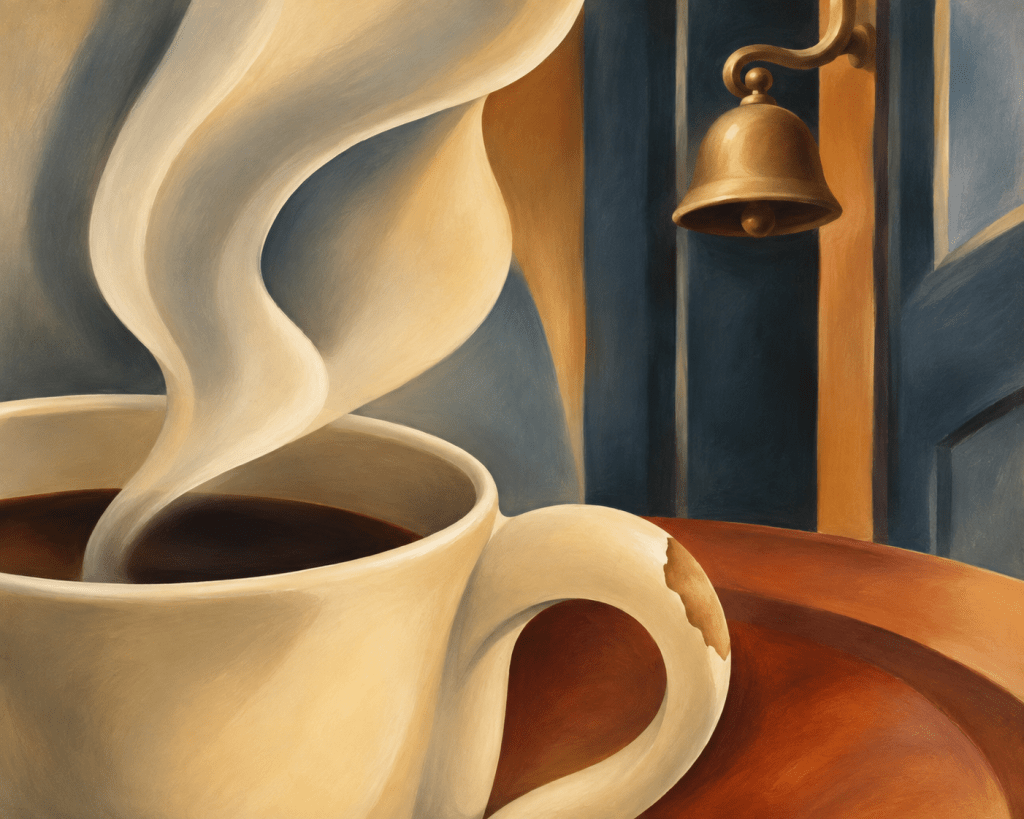
we were sitting by the front window of a little coffee shop where the floorboards bowed slightly toward the door and every time someone came in, a brass bell interrupted every conversation.
It was late November.
The kind of afternoon when the sky can’t decide whether to snow or watch the birds begin their migration for warmer states.
I remember because my coat was still on and my tea had gone untouched,
steam lifting in thin pale ribbons between us,
curling past his hands.
His cup was black.
Mine was chipped cream,
a small crescent missing from the handle where someone before me had held on too tightly or not tightly enough.
Life is that way, isn’t it?
There is more than one way to break a thing.
Outside,
a young mother pushed a stroller past the glass,
one mitten in her teeth, one shoelace loose, her little boy turned backward so he could watch something he’d already passed on the pavement but wasn’t done admiring.
Probably a bug.
Little boys tend to linger over bugs.
Then Jack asked,
Why haven’t you had children?
Not suddenly.
Not heavily.
As though he were asking whether I preferred blue to red,
or hardcovers to paperbacks,
or why I always chose the corner seat facing the door.
I smiled first.
People do that when the body is buying time.
I wrapped both hands around the mug,
felt warmth press into the center of my palms,
and said what had become second nature by then—
The Lord just hasn’t given us children. We tried for a long time. It never happened.
Jack lowered his eyes for just a moment,
thumb brushing against the folded edge of his sleeve,
as though what I’d handed him required care.
Then he looked up and smiled through two pauses and a beat.
You would have made a wonderful mother.
And something in me, quiet for years, sat up.
Or maybe tripped?
A hinge.
A draft.
A room I thought I'd already closed.
After that,
life kept happening.
Conversations that began with nothing—
music,
students,
road construction,
the shape of clouds—
and before I understood how far we’d traveled,
the man who first asked why I’d never had children
was speaking as though he already knew what ours might look like.
Months later,
there were little white pills lined up beside my bathroom sink,
half a cracker,
a glass of water,
the morning moving slowly through the blinds.
And still—
Jack spoke of blue eyes.
A crooked smile.
Long fingers.
A laugh that would sound like mine.
And somewhere between longing and nausea from the pills meant to keep her away,
our daughter had a name.
Clara.
I said it once alone in my kitchen,
bare feet on tile,
the dishwasher humming,
afternoon light moving across the counter so slowly it looked like a memory.
I stood at the glass door, watching.

Beyond the stone deck
and the birdhouse

two delicate blue eggs
lay nestled atop carefully arranged
blades of grass.

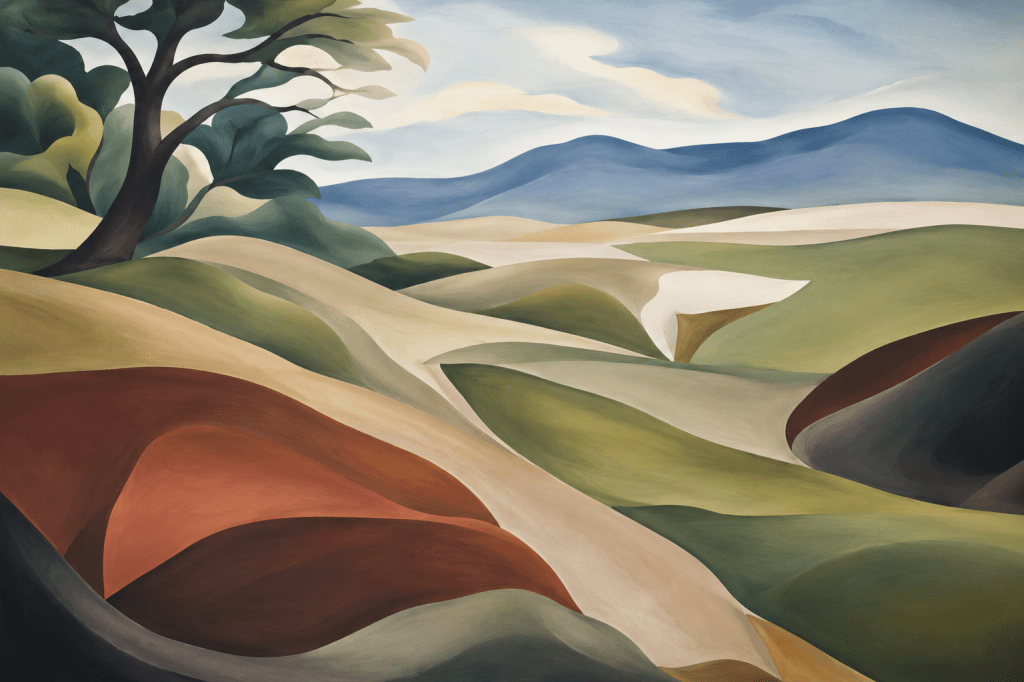
The field beyond the fence
was bright with spring.

A tree named Walter
lifted its branches into the morning.

Every tree within daily view
should have a name.

A dog bred to bear burdens
wandered lazily through the grass,

distracted by an over-dramatic cardinal

or maybe the way
the breeze had begun to smell like
spring.

The coffee in my mug tasted faintly
of hazelnut and milk.

Scrambled eggs cooled on a plate.

Cologne drifted through the kitchen.

The juice from a red grape
slid down the back of my throat.

The field was busy with singing.

Not birds alone.

Something larger.

Something hidden.

The busyness of living
moved through the grass
like wind moving through
tousled hair
or waves crossing the sea.

At the time,
I thought the field would always be there.
The eggs.
The cardinal.
Walter.
The dog.
The glass door.
The man standing somewhere behind me.

Months later
he disappeared.

Then the seasons continued
one second
one hour
one page
at a time.

Summer crossed the field.
Autumn followed.
Winter bent the grass flat.

One afternoon

I found myself standing
on the opposite side of the same field.

Far beyond the fence.

Far beyond the glass door.

Far beyond the woman
who used to stand in that kitchen
and watch.

The singing was gone.

The grass was gone.

The hill itself
seemed smaller.

Yellow machines moved through the earth

lifting,
turning,
leveling.

Steel teeth entered the ground.

Mud spread where pasture had been.

The field I remembered
was being dismantled
one scoop at a time.

A subdivision would stand there soon.

Roads.
Mailboxes.
Driveways.

Children who would never know
there had once been a field.

I watched for a long time.

Long enough for the machines
to continue their sweaty work.

Long enough to notice that
Walter was still standing.

Long enough to realize
that I was no longer looking
at the same landscape.

Or from the same place.
Or through the same eyes.

The field stretched between
what had happened

and what remained.

I stood,

watching the earth being turned over,
feeling the soil being turned over,
tasting the smoke and smothering

just a little.

"What if I take one step backward?"
I wondered.

"One more,"
I whispered.

Artifacts churned
deep and then deeper
burying and then
buried.

And I drove away
waving to Walter
in the rearview mirror.

— Iris Lennox
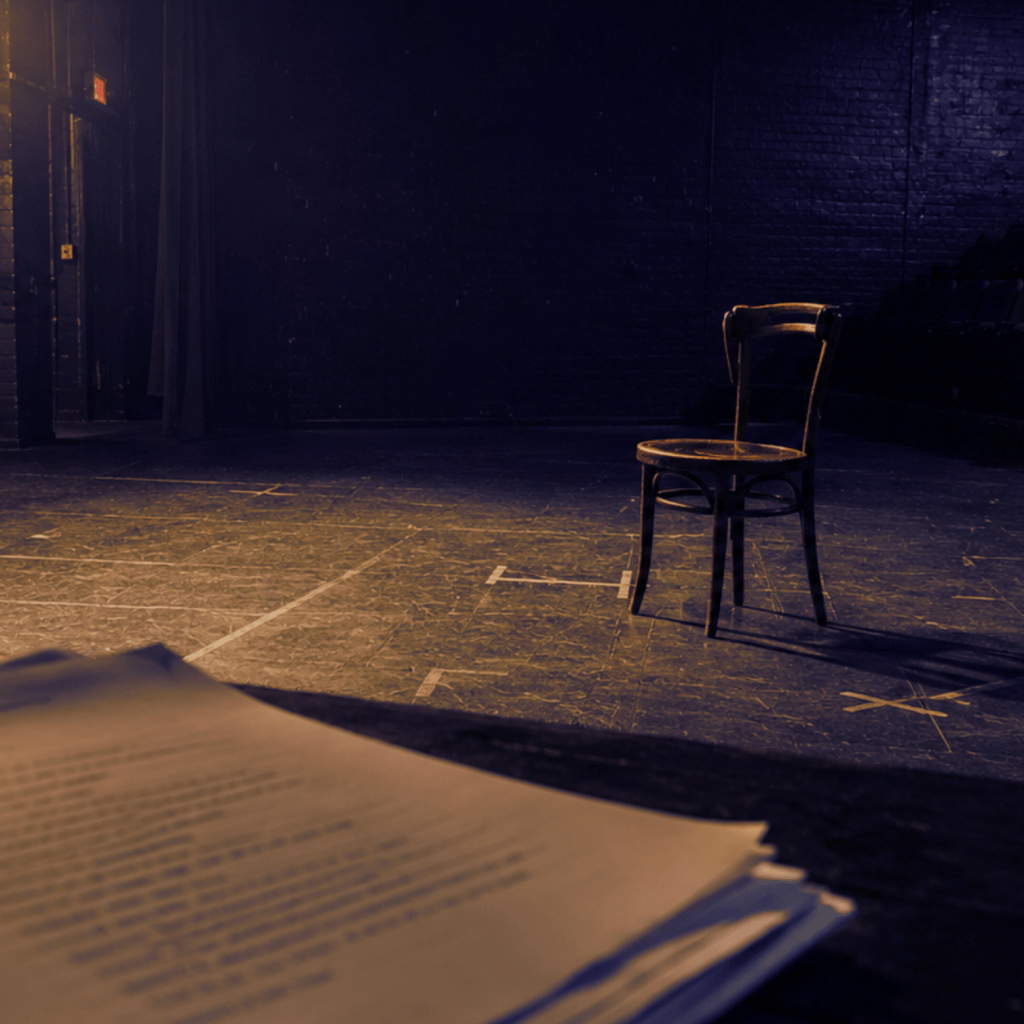
I spread the pages across my kitchen table, one hand on oak, the other on language.
Afternoon light finds the margins first, then the staples, then the black strokes of my name pressed hard enough to leave its mark three sheets down.
Good.
Some truths deserve depth.
The paper remembers dates.
It remembers names.
It remembers who stood where, who reached first, who kept speaking, who went silent, who needed silence to feel safe.
The ceiling fan turns.
Edges lift, but dare not fly away.
They stay. Pressure makes some run and others stay.
A throat is made of cartilage, muscle, membrane, two pale folds opening and closing over air.
Pressure meets tissue.
Even a whisper requires force.
I know this.
I have taught students to plant their feet, unlock their knees, drop their shoulders, open their ribs, and send a line to the back wall without asking the room for permission.
Never ask for permission.
I have watched a frightened girl find her stomach and then her voice.
I have watched boys speak one true sentence without laughing and become men.
I have watched language enter the body and change the way a person stands.
So when the hand came, when the pressure came, when silence came to wrap around, to shut me down, to choke me—
I know what a voice is.
The larynx bruises.
The breath adjusts.
Once, I lost it.
But don’t worry about me.
I just drink the tea, bite down on the Ricola, and breathe.
Shakespeare told us long ago,
“Speak the speech, I pray you, trippingly on the tongue,”
And I tripped.
A little.
Then I got back up.
And spoke until cartilage, muscle, membrane, air, ink, oak, paper, rooms, whispers, and men who mistake women for little girls
had to listen.
They reached for an instrument they didn't understand.
So I took what the body knew, what the stage taught, what the page required, what courage costs,
and I used all of it.
Outside, water climbs through xylem, one molecule pulling another.
Roots enter limestone by touch.
A seed splits in darkness
and takes root.
What does paper know of life?
Only what we tell it.
—Iris Lennox literary pen name of Jill Szoo Wilson
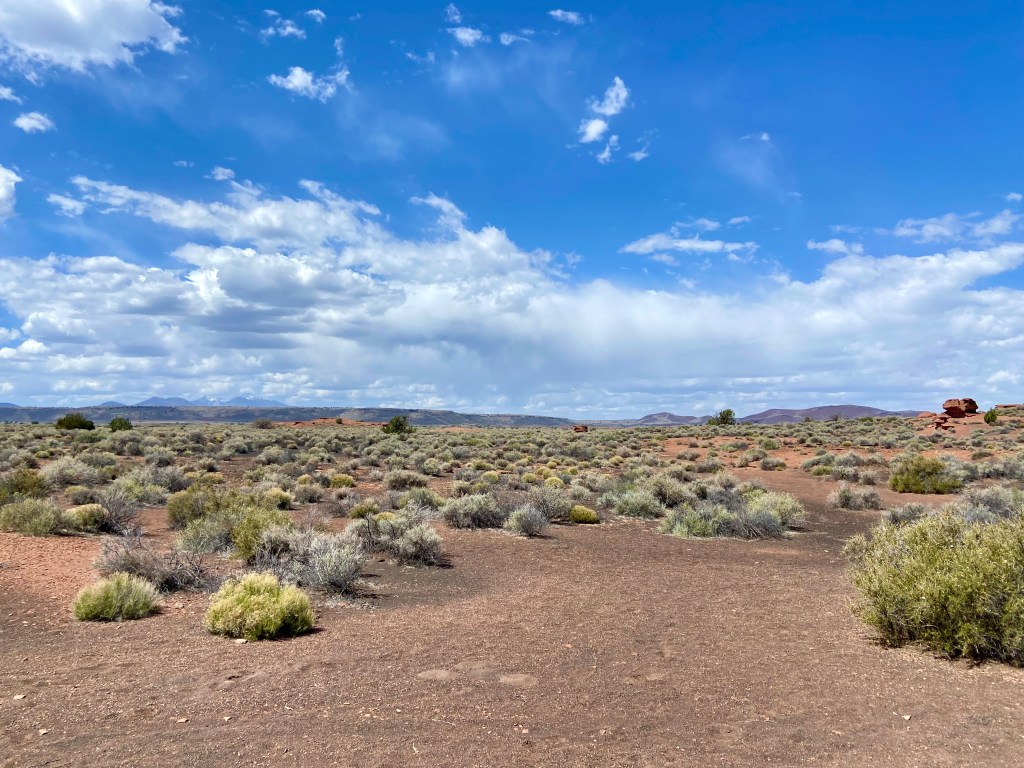
Morning lifts from the desert just before noon. I immediately regret each moment I missed— where was I when the sun rose here?
Light moves across basalt, sage, rabbitbrush, the red earth reflects warmth back into the blue.
Sunshine and earth, a love affair.
A strand of hair crosses my mouth and tickles my nose— as I swipe it away, I discover heat-burnished tenderness.
Sunshine, earth, and me— a love affair.
When I first arrived, I heard the crunch of my boots and all I brought with me. Water and ice sloshing against steel.
Also
half-finished conversations. A list. A sentence. A prayer, still wanting to know Him more.
Then the wind rises through the sage
and every branch answers.
Not all at once. Antiphonal. There must be a conductor here somewhere.
One stem, then another, then a hundred more clicking, brushing, rattling in no hurry to finish the song.
I have a feeling the song began at the beginning and will go on forever— it is a gift to hear this movement.
A Common Raven crosses low over the wash,
wings opening like someone who knows me and awaits my approach to the threshold.
Clearly, I am welcome here.
Higher still, a White-throated Swift not to be outdone cuts through the blue so quickly I hear the turn before I find the bird.
At my feet, a bee disappears into yellow rabbitbrush, comes out dusted, and goes right back in.
I'm proud of the bee and respect it enough to be a little scared, too.
Farther out, a Horned Lark drops three clean notes into the open country and flies off again. I'm struck by his boldness in speaking and not waiting— tell the truth, then let the echoes do the work.
Beauty and truth— companions from here to Kingdom come.
Even the grasshopper seems to understand.
Click. Up. Moving on. Trust.
And between all of it—
space.
Wide, sunlit, unoccupied space.
The kind that only exists here and anywhere there is desert. Around the globe but this one is mine, today.
I stand until my thoughts up. Click. Moving on. Standing still—
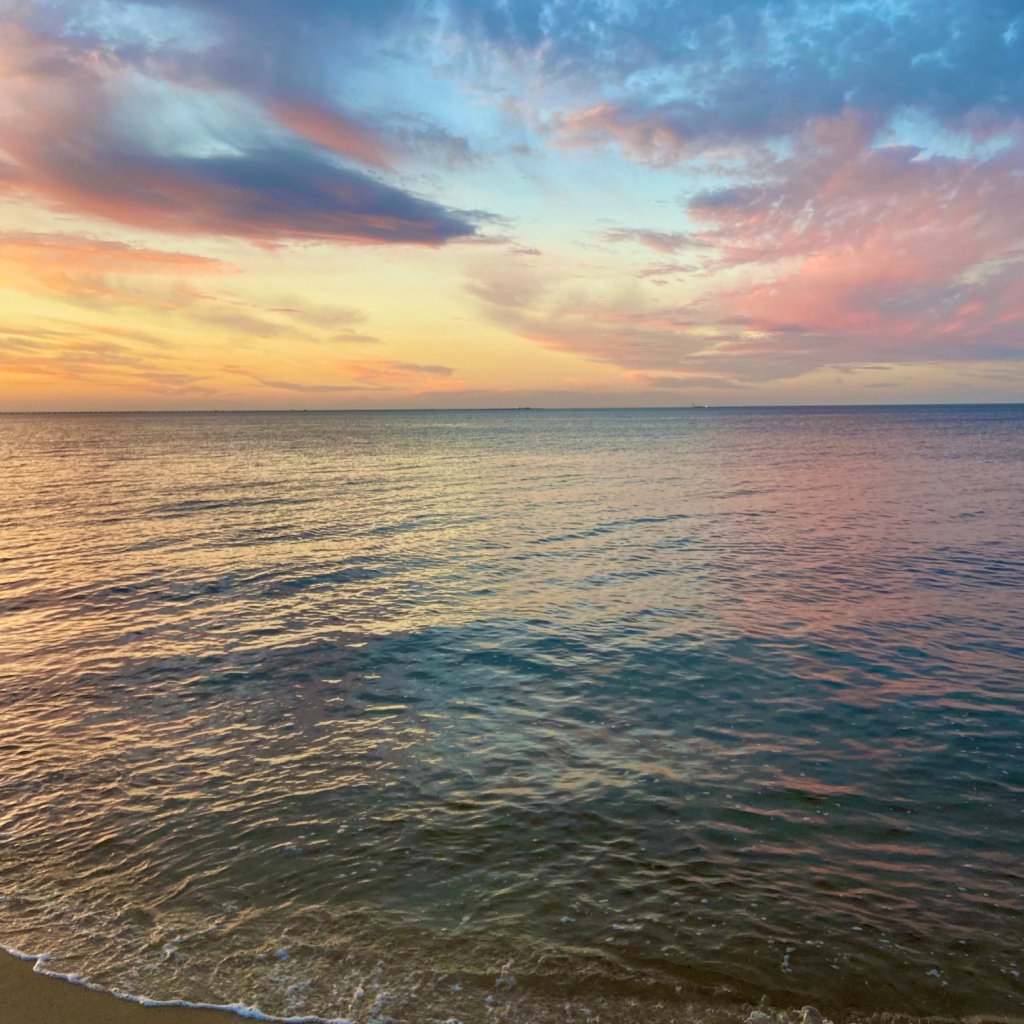
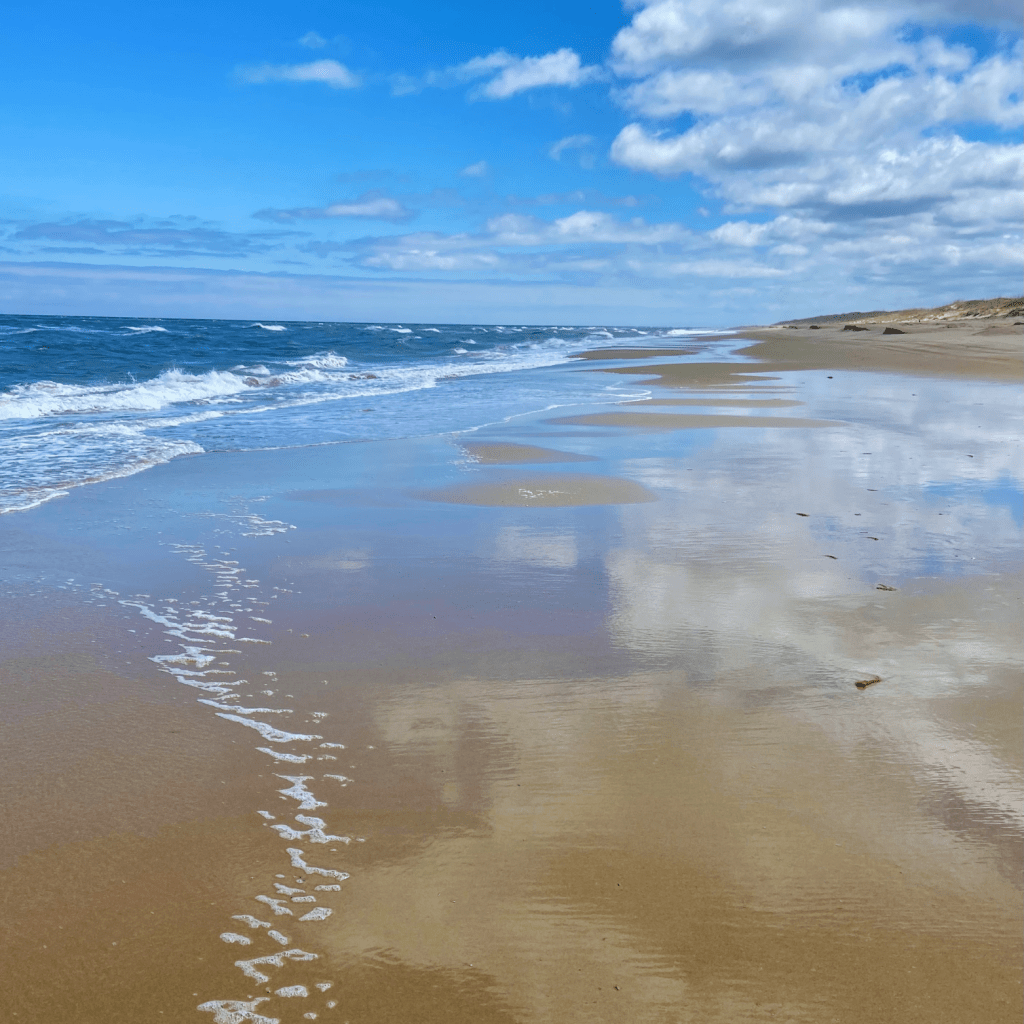
As he leaned down toward the sand, his knees creaked under cotton trousers and then grew quiet again.
Kneeling, he sunk his finger between a million grains to write a message there— first a W and then an H, followed by a Y?
He drew a circle around the word as though the spelling alone lacked power to catch the eye of anyone who might be qualified to enter the quandary with him, for him, take it from his hands, lift the weight, and carry it away.
His hair used to be black— until it was grey— and in the wind that hovered above land, after being cast from the sea, his curls lifted and fell like waves, answering the whims of the moon and gravity.
He placed his hands on top of his thighs and stood, once more facing the mystery of tossing foam, his question scrawled below and below— in the center of himself— doubt churned under a stomach filled with acid and disaster.
Like bricks, a collage of faces, a map filled with places, melancholy traces, unending races erected a wall inside his soul too high to climb, too wide to choose whether left or right might end the mounting fight.
Hiding in plain sight, he felt alone until he was not— she stepped in close from a shadowy distance to share his pool of light, breaking through the clouds, illuminated by the night. The two stood staring, astonished—
“How did you find me?” he asked— she had no certainty to give. “I don’t know,” was all she said— he brought one hand up to his mouth as though to stop the words from coming out. “I needed to be found.”
They stood above the crudely scribbled “Why?” and respected its presence as a minnow respects a shark. However, they refused to bow their heads in reverence for the question and, instead, they walked together hand in hand, and waited for answers to roll in with the tide.
Music wafting through the air or is that birds or Tinkerbell? I got some dust inside my eyes so it must be the fairy swooshing by.
Marching bands with brass and bass kings and princesses take their place to tell the story— the same one again: a far away land a witch and a hand given in fanfare to a sashed, bare-faced man.
There are rides to be taken heroes who capture and race down adrenaline-filled paths that feel like lov— no, rapture.
Slow and then fast through dazzling light enough to fly past the machine in the back and the character smoking with his head hung on a rack—
We agree not to see.
Lights flicker gold and then blue wait—did he just look or did he look through? A pause in the motion something like timing I take as a cue.
Confetti drifts ash, or snow touches my sleeve then lets me go I leave it there— a moment too long part of the set and now so am I
—and who am I?
I forget.
Voices echo layered thin— his or theirs or somewhere between I turn to see then let it be what it was I could have sworn the words pointed to you.
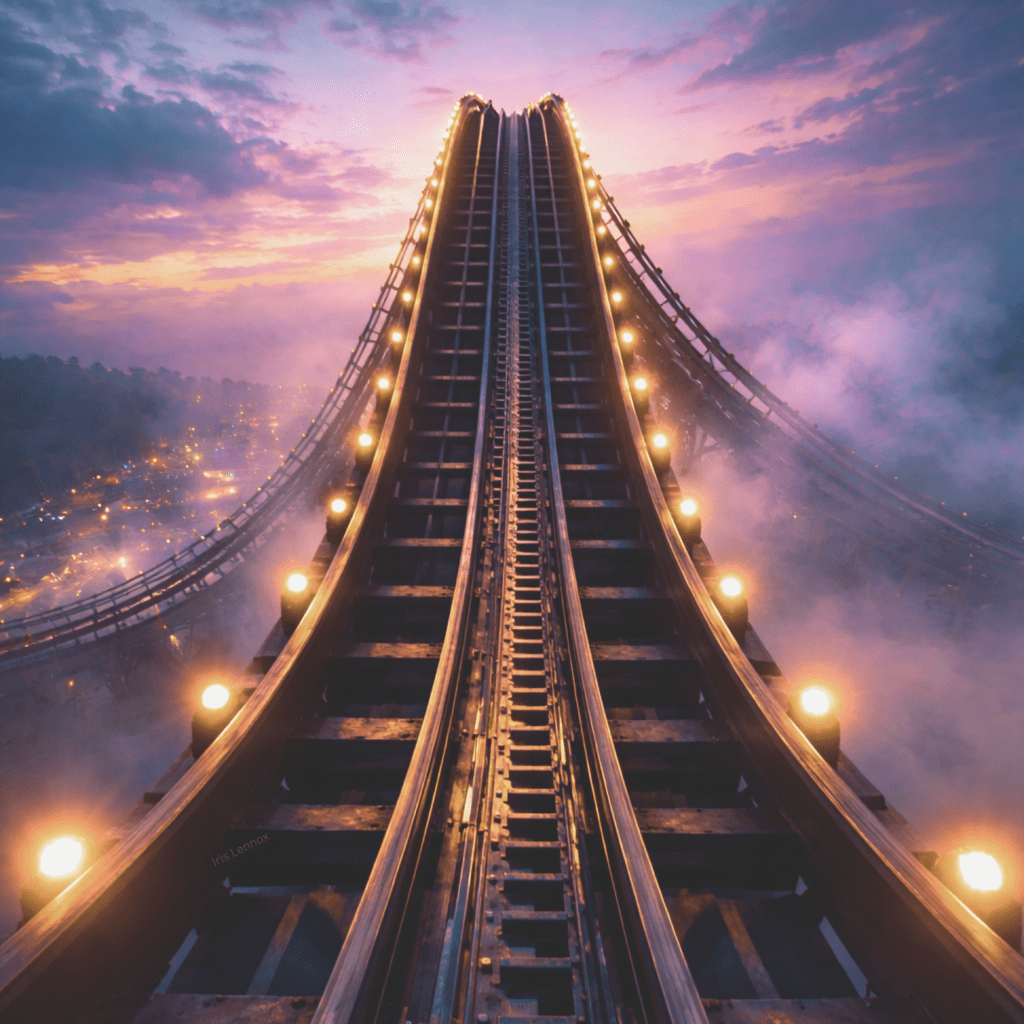
The track tilts— just slightly off enough to blame on atmosphere or thought I steady once then sit up again and see the path has gently bent
not back not through—
just near
A mirror placed at child-height glass returns a face I almost pass until it lingers half a beat—
more sure of you than it is of me
A worker sweeps the same small spot back and forth as if it’s not already clean already done—
I watch too long then call it one of those things that people repeat to keep the edges soft and the picture neat.
A door marked STAFF stands open wide no one there but light inside. I look—
then don’t—
then walk beyond
back into sound and colored air where something waits that isn’t there or isn’t mine— but knows my name well enough to feel the same
The music swells— or something like it close enough that I don’t fight it I take my place without a claim
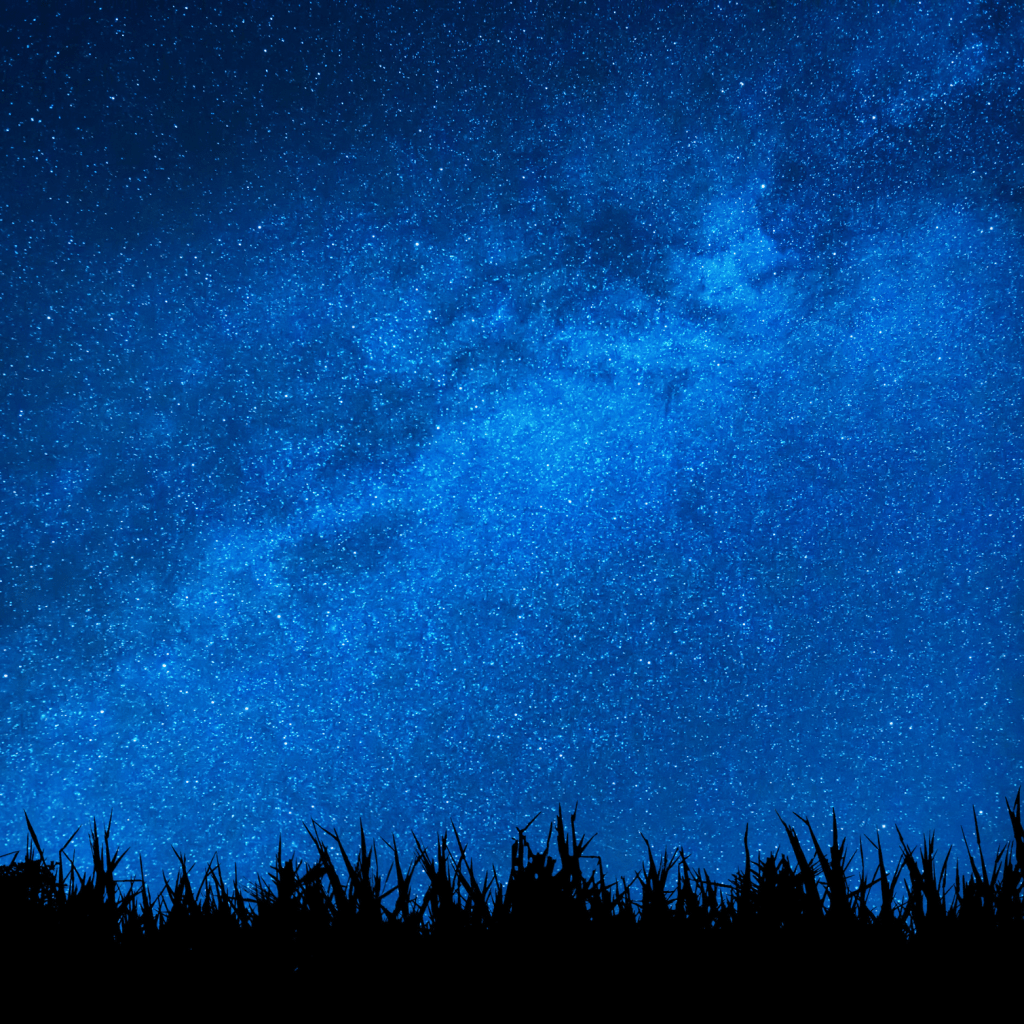
Surrounded by air and invisible strings attaching to all corners of the universe, there lies a star in the sky. The star’s name is Vincent, his moniker bearing the stamp of the famous painter on Earth to whom his mother was introduced when one of his paintings was lost in space and drifted across her gaze.
Vincent is lazy, and his breath is a series of inhalations and exhalations shaped by boredom. He has learned not to expect entertainment from his fellow floating orbs. The splendor of their illumination is juxtaposed by their inability to sing or dance or, in any way, delight his fancy. They lie scattered across the galaxy, telling stories about the things they’ve never done, the places they’ve never been, and the memories they’ve never actually made.
The sky is not liquid, but it is still. Except when comets come screaming past their stuck counterparts, or when a star burns out and drifts away, movement is not allowed. Change rarely occurs. Vincent is fixed in a fixed state, and he has given in to the stuckness of his existence.
Vivienne is newer. Relatively new. She has not yet lost the fervor of her “what if” and dreams of destinations beyond the darkness and points of light by which she is surrounded. Vivienne is vivacious and full of wonder. Her curves have not yet been chipped away by the chisels of time or NASA’s rumbling past her looser rocks. She is intelligent, bright, an artist at her core who does not spend time lamenting her lack of limbs. Instead, she fills the sky with her songs and laughter and tells stories born in the dreams she has when she closes her eyes to sleep.
One day, a spacecraft flown by human hands nicked the side of Vincent’s ribs. It was clearly an unintended greeting, and it caused Vincent a lazy amount of consternation.
“The NASAs don’t understand space, am I right?” he dribbled out sarcastically as his body reacted to the impact, shifting ever so slightly to the right.
As his roundness rotated by infinitesimal degrees, Vincent suddenly saw a new perspective. The view he had held for centuries had been just slightly off to the left. As his eyes adjusted, he whispered into the darkness, “What the—”
Newness.
Vincent shook his head and closed his eyes. Then he opened them again, trying to adjust his vision. A bit near-sighted, he had to refocus once more. When his eyes opened the second time, his heart filled with wonder. He could see stars he had never seen before. A draft brushed against his back in an unfamiliar way. The stars newly visible to him were sleeping, ignoring the NASA that had just shifted his perspective.
One of the stars he had never seen before was snoring.
As Vincent would later learn, the snoring star’s name is Dick. Dick, known as Richard to those with whom he is not well acquainted, wears a smoking jacket and smokes a pipe in his mind. He pontificates on matters such as the romantic lives of the earliest stars and prides himself on knowing intimate details about the moons surrounding each of the planets.
For centuries, a rumor circulated that Dick once sent notes of love and longing to Europa. Europa, one of Jupiter’s moons, has a voice like a hushed flute, high, soft, arresting. Dick’s love notes were legendary, poetic, stirring a romance so engaging that hardly any stars within several light-years slept during the centuries of their affair.
Until Europa broke his heart by falling in love with another of Jupiter’s moons, Ganymede. Since then, Europa and Ganymede have whispered to one another, keeping their romance private. Ganymede is not nearly as showy a suitor as Dick.
And so, the sky lost its drama. It returned to the mundane: blackness, occasional pirate songs, the same stories told to the same stars, over and over again. The order of the sky began to resemble the Moose Lodge from The Flintstones, the same people, the same stories, the same faces.
Until the gods allowed a NASA to nick Vincent’s side.
That small disruption sparked the possibility of new sightlines, new encounters with stars whose old stories would be new to him. When two personalities meet for the first time, it is not only their lives that shift. Those around them feel it too. Energy renews. Sometimes for the better. Sometimes not. Always for the new.
Vincent widened his eyes and took it in: the lighter shade of black in the upper right corner of his vision, the way surrounding light now touched the edges of his face, the unfamiliar stars whose voices he had heard but never seen.
A sense of wonder filled his old heart. Something stirred inside him. It sounded like a triangle tapped lightly, like Tibetan bells ringing, like a finger drawn slowly across the surface of a gong. A deep, peaceful awareness of life, and his aliveness.
Vivienne yawned, long and breathy, and opened her eyes as a NASA sped past her head. She blinked once. Then again.
And in that second blink, she became aware of two eyes she had never seen before.
They were looking back at her.
She blinked again.
Vincent wanted to speak, but instead, he blinked too. Four blinking eyes, fanning something into flame. A steady fire.
From that moment until now, Vincent and Vivienne hang on opposite ends of the sky. They do not speak. They do not sing. They do not send notes on the backs of passing NASAs.
They hang, separately, gently, precariously, held by invisible strings attached to all corners of the universe.
And they blink.
And open.
And blink.
And open.
They cannot move toward one another. They will never touch the surface of each other’s being. Even so, they remain connected, by the turning of Vincent’s perspective and by the quiet recognition that passed between them.