You might as well befriend the moon— embrace her clouded peekaboos. And music…
Receive the tune— no time to choose— alone in a crowd or no one in view. And a smell…
Wafts past your nose— what was that? Or who?
Perfume on skin or a place that you knew.
Pause.
No need to wonder— you know who that was— and who you are as nostalgia winds the second hand round.
“Time is a straight line,” said he. “It moves consecutively, watches as it goes behind and below, like walking a path that winds into— well— no one knows.”
“No one knows, that’s right,” said she. “Simply put, I do agree. But there’s no line to speak of. Time bends—not like a knee— more like a finger touching its thumb or a rainbow finding its spherical end and answering with a gentle, Come.”
Time returns to the places we’ve been.
One says, “That memory is far.” Another, “The moment is here.”
Yesterday can be set down, but the nows of that day rise from the ground without notice or sound—
to delight or confound— it depends on the seconds into which they were bound.
Moments become recollections. Recollections, seeds with a life of their own.
Promises and hope, gentleness and rage, a touch, a glance, a well-appointed room or a half-written page—
all sown into skin, finding rest in smiles and tears, repose and toil, love and loss, freedom and cost, and the way sunlight lay across the earth at the end or when it all began.
“That was back then,” said he. “That is today,” said she.
The minutes listened.
“There is wisdom in both.”
Time smiled— crouched, quiet— behind an autumn tree, waiting for the final leaf to fall.
It begins with a question as most things do— standing still and not understanding and then, why? Sometimes, how?
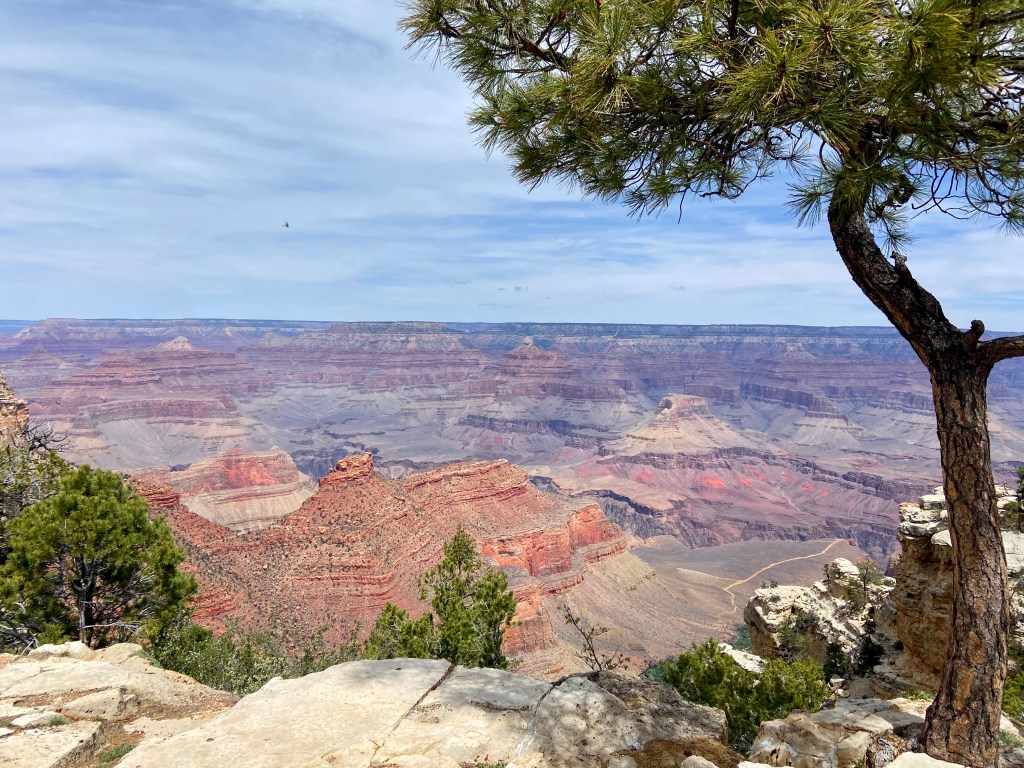
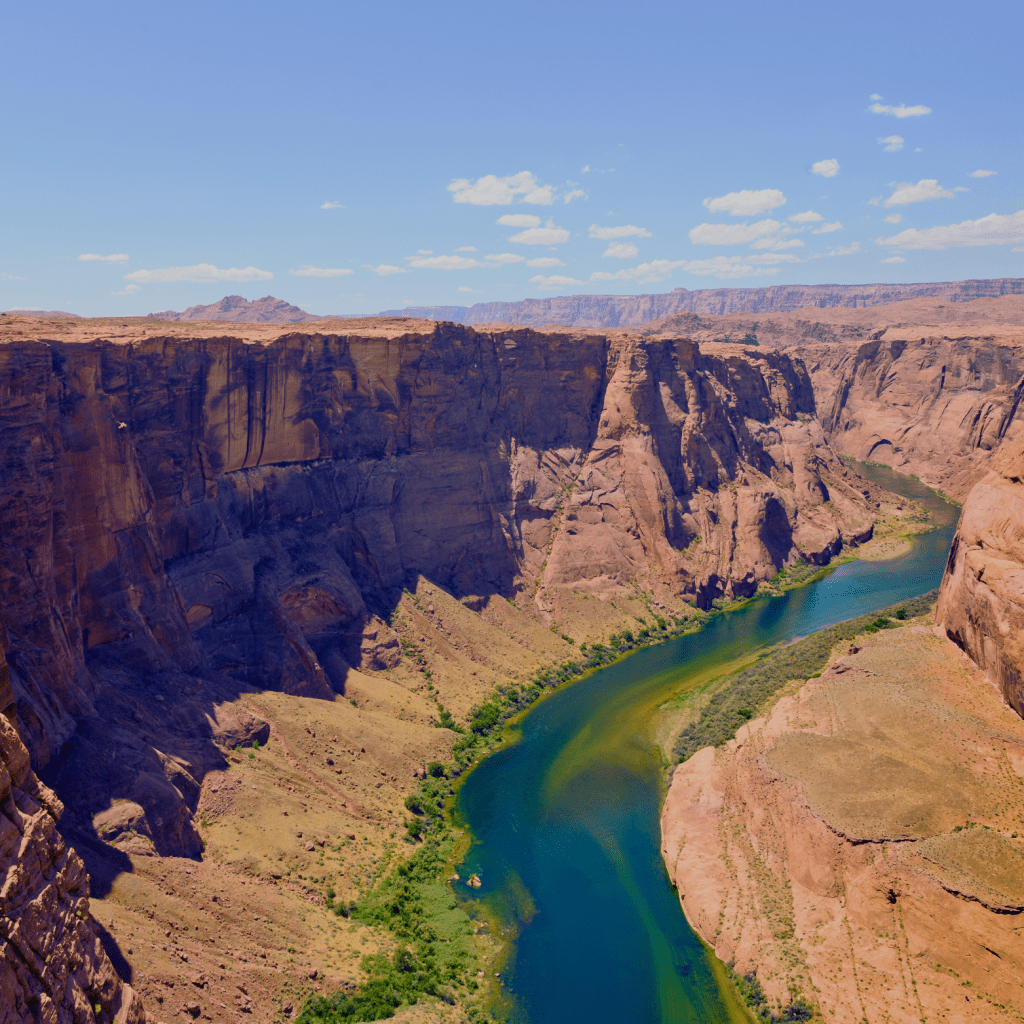
Before me— bands of color arranged with conviction, clearly the earth has already decided what each layer means and is in no hurry to explain itself.
The greatest beauty rarely does.
Someone wearing a mud-stained hat and pants that swoosh when he walks has named them. Kaibab Limestone at the rim. Toroweap beneath it. Coconino Sandstone—once dunes, moved grain by grain under a wind that no longer blows.
This was a desert, then a sea, then something in between that does not translate cleanly into a single word.
Mystery mingling with majesty.
I look at the red— Hermit Shale, perhaps— soft once, willing to be shaped, now holding its position like a memory that has settled into fact.
Further down, older still, Vishnu Schist— stone that endured heat, pressure, nothing erased, everything contained and displayed— a record I cannot read, written in a language I have not learned. But I recognize this:
Resilience.
Two billion years, give or take. The number means nothing to me other than "Wow."
The mind attempts a comparison— a human life, a century, a civilization rising and falling somewhere between two lines of rock.
It does not help.
Below it all, the river— still working. Still carrying what it has loosened. Still, rippling with stories that continue.
The Colorado meanders. It does not rush for anyone's benefit, the way an old man has learned to slow down. It cuts because that is what water does when given time and a way through.
I find myself asking questions that have no immediate use.
Who first noticed that this was once sand? Who looked closely enough to see ripple marks held in stone?
Who intuited that knowing this made the view larger and more intimate at the same time?
The tree beside me leans into its own inquiry, roots set in an answer that does not require words.
Its needles move in present tense.
No concern for uplift, erosion, continental drift— that long, slow negotiation between plates.
As for me—
I want to know how something becomes— how pressure instructs what to keep and what to release.
How absence— of water, of time, of witness— enters the record.
Curiosity does not simplify. It accumulates.
Another name. Another era. Another process quietly at work beneath the visible.
And suddenly the canyon is no longer wide.
It is specific.
I stand at the edge with a growing suspicion—
that beauty increases with knowledge,
and that time, unmeasured and indifferent, is not empty distance but the most patient artist I have ever encountered.
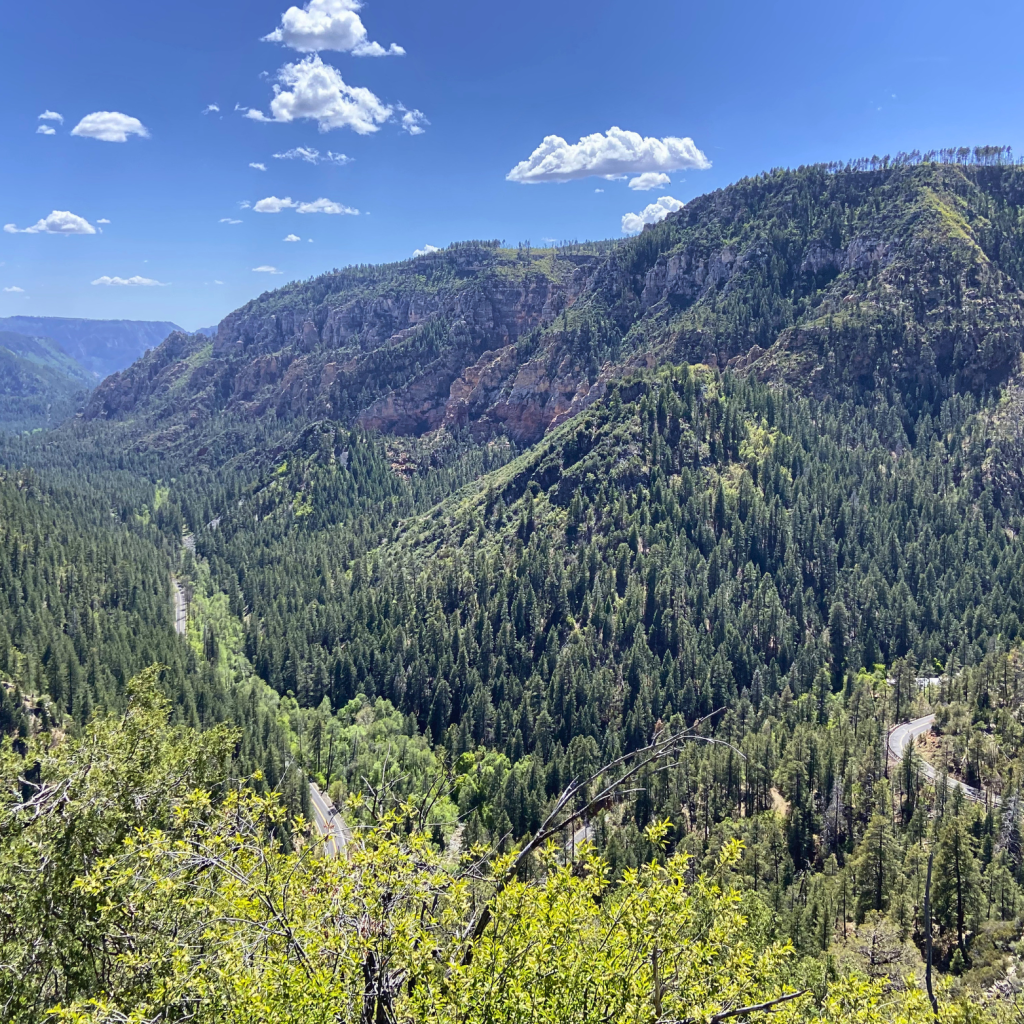
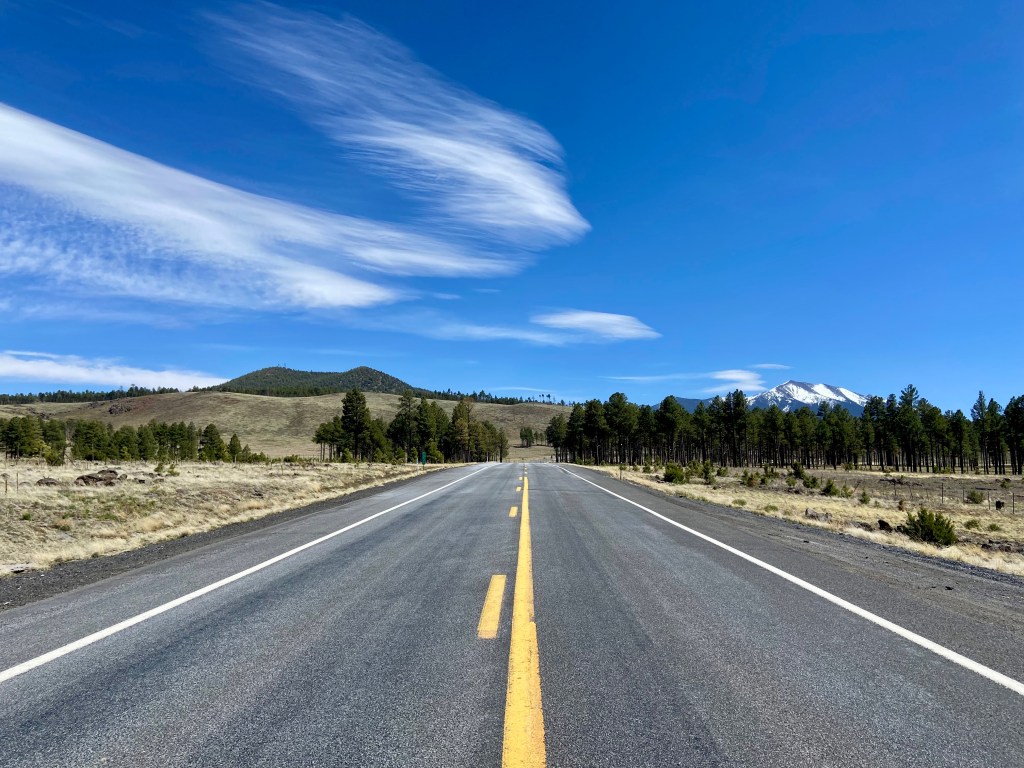
The road is empty, so naturally I walk to the center and stand on the line.
Silence but for the tapping of the cooling engine and the sound of waves— or maybe wind— blowing through pine needles.
Yellow lines under my feet— broken, then whole, then broken again, each piece looks like it's racing but I know better: resting.
Ahead, the road lifts.
Not much— just enough to take the next stretch out of view.
Driving, you don't notice how pretty the variation of black, gray, and blue after years of repaving.
You just keep going.
Inside the car you are listening, or talking, or thinking . . . anticipating, over the hill, onto the next stretch already laid out.
Standing here, the journey slows then stops.
Everything here knows one another and all is stable, but the wind and the clouds and the sun and moon and stars— but the road.
Each yellow line serves a purpose to guide to rightly divide . . . but also to watch to remember to enjoy?
It occurs to me in the middle of the road:
Trust in the Lord with all your heart, and do not lean on your own understanding. In all your ways acknowledge him, and he will make straight your paths.
No matter how fast or slow I move, God.
The road is the road.
The adventure— where I go— is up to You.
—Iris Lennox literary pen name of Jill Szoo Wilson
The photo is courtesy of Pixabay because my iPhone 12 didn’t quite cut it.
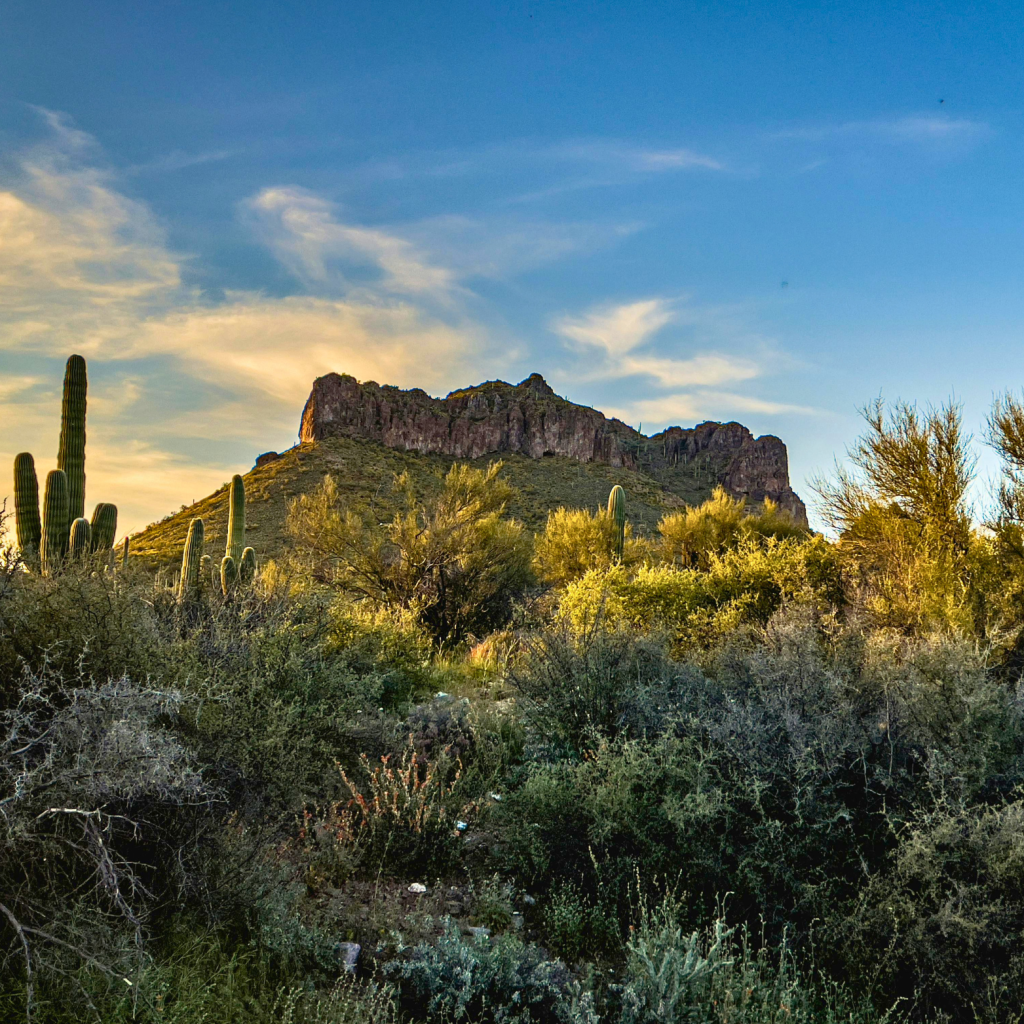
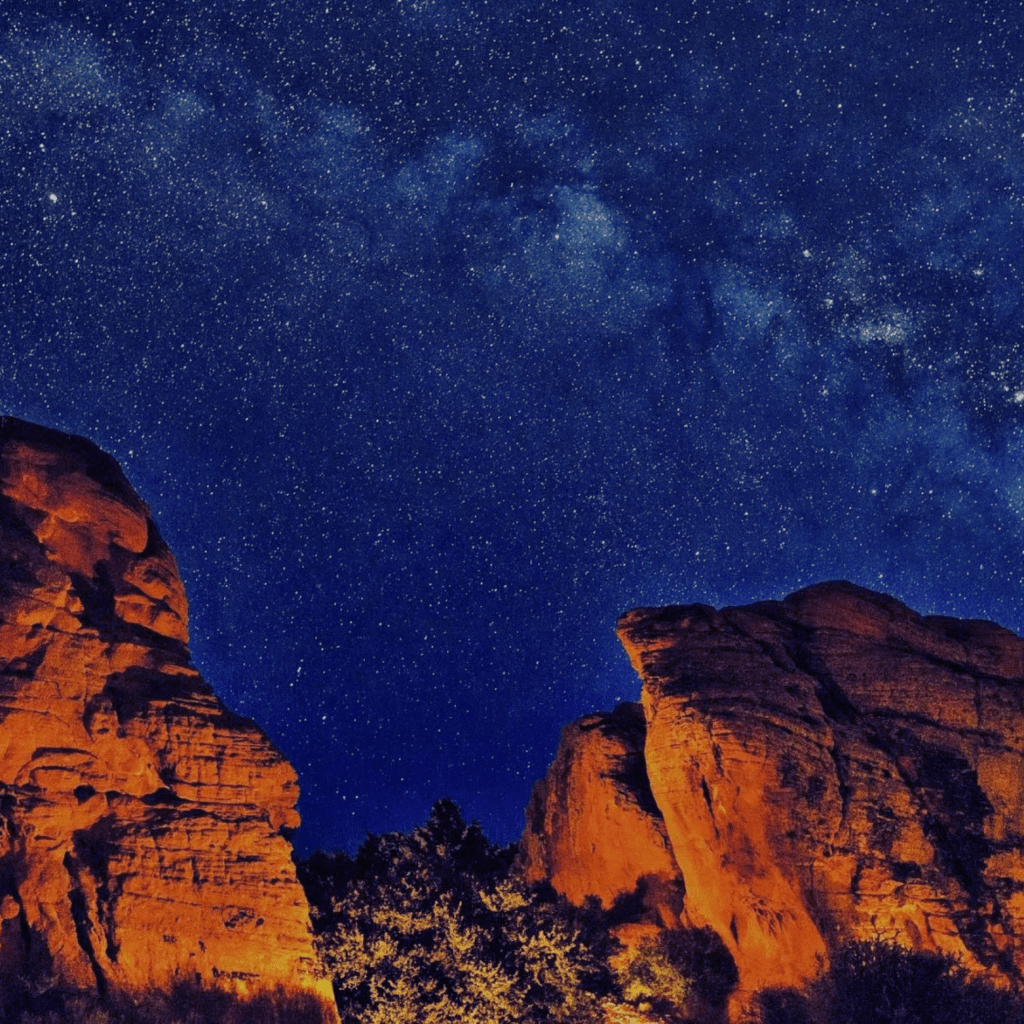
Night settles over the desert and the sky draws back like a curtain on opening night.
Stars peer from the wings and then enter from every direction— innumerable, but every one commanding attention.
I lay my head on my daypack no longer needed because . . . well, night . . . light arrives from distances I cannot measure, each point steady, each one burning fiercely but without sound.
Around me, the land falls into a hush that is greater than quiet— stillness.
Stone cools. Air thins. The last traces of what the sun gave rise from the ground and into the sky, probably trying to join in the celestial production.
Lucky.
Here we are in the chaos— for a time— but above, order.
Not scattered, not random, but placed.
Line after line, field after field, a vastness that neither moves toward me nor recedes.
Tightrope walkers, all of them. The theatre? Or a circus? None of my metaphors matter.
Every person stops— and you can understand why
why the eye lingers, why the body quiets, why the heart bends and breaks and mends and unfolds all in one inhale.
The sky doesn't look back. It doesn't need to. There is nothing we can give to it except wonder.
Brilliant, unreachable, unaffected.
And still— it draws.
The ground beneath me, the sky above me, the measure between them—
all set in order, all kept in place, all speaking without voice.
In the keeping of it, in the placing of each light and the distance between them, God gives:
what is set in the heavens and seen,
what fills the eye and commands attention—
and wonder— not as something given,
but as what rises in us at the sight of it,
returning, not to the sky above, but to the One who directs its course.
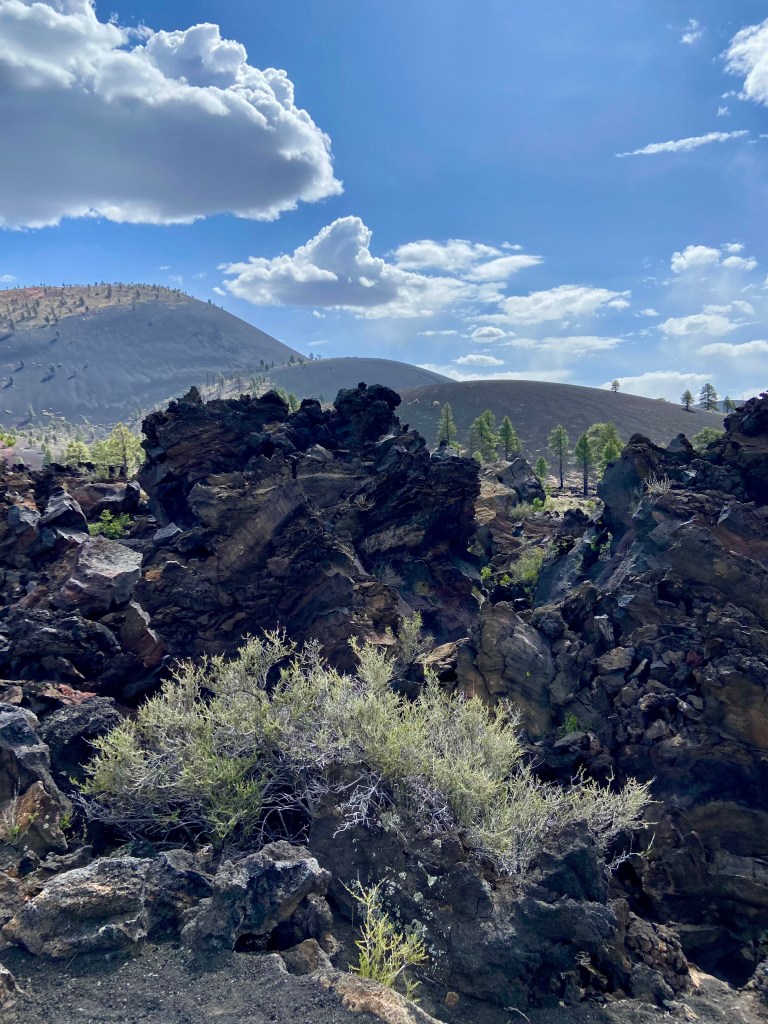
At the edges of Sunset Crater Volcano National Monument, stone lies where it came to rest.
Dark, porous, each piece holding the memory of heat, each surface fixed in the moment of its becoming.
Across the field— fragments.
Lifted, scattered, set in place by force and the long settling after.
In the slow passage of it— through wind, through cold, through the steadfast work of seasons— a different order solidifies.
Between the stones— vibrant lime green equally brilliant yellow
Pushing through fissures, rooted in spaces of fracture, drawing from elements above and below, rising from where the earth was devastated.
A bird alights on a twisted branch.
And we, who come searching for shape, stumble through the surface, reading the ground for what we imagine, while beneath our steps roots move among the stone, threading through death and life.
On the surface— rock, jagged silent warnings emanating from frozen faces.
Beneath— a rumbling of breath, forced tilling turned to growth, through time's signature shocks of courage.
The land holds both together, dividing nothing, choosing neither.
In the keeping of it, in the settling of what has been cast down and the quiet rising that follows, God gives:
what remains where it has fallen, set in the ground as it came to rest—
and what takes root within the break, drawing life from the opened places—
and healing— not as the return of what was, but as something new set among the fractures, color rising—but more, the story not only of wreckage but of life where the ground came apart.
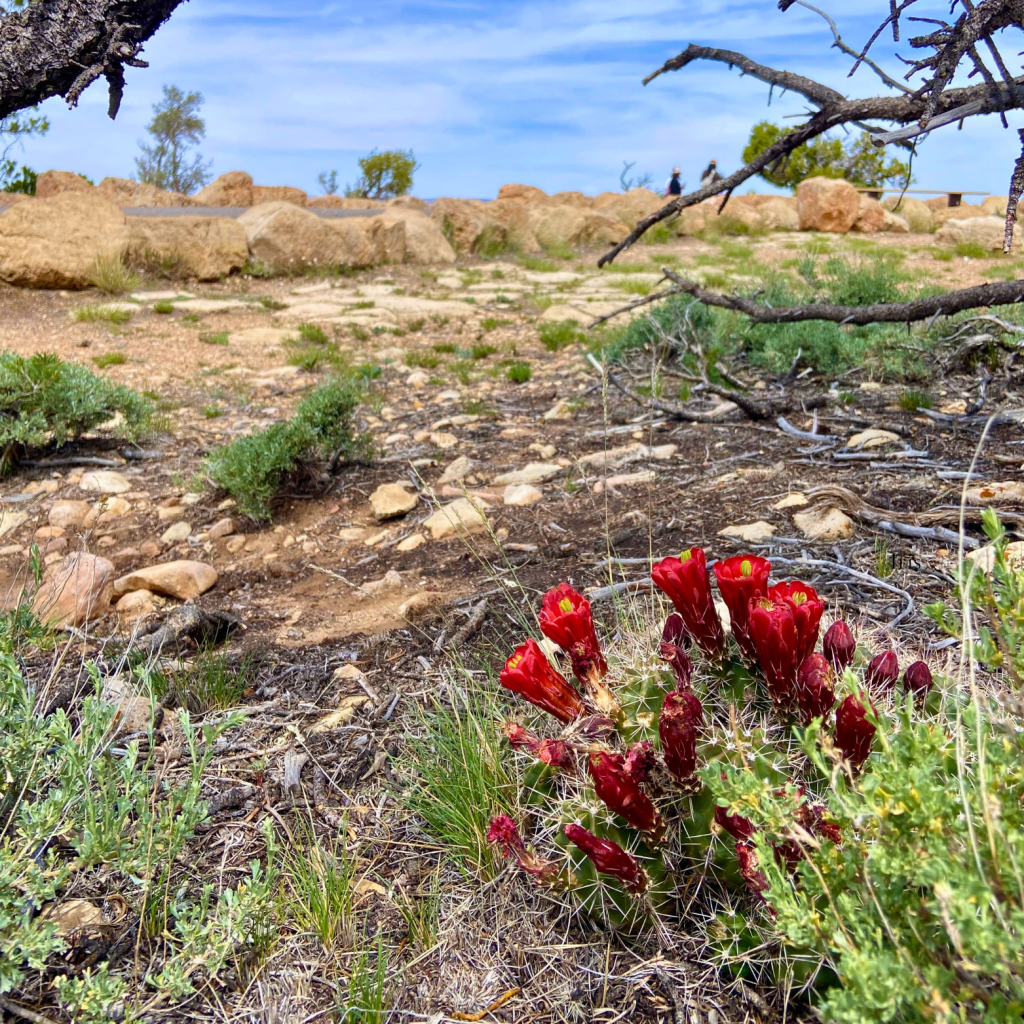
At the rim of the Grand Canyon, Without widening, announcing, or calling the eye— it gathers.
Close to the ground, armed at every point, it holds what little comes— light taken in, water kept, time pressed inward until it thickens.
In the long discipline of it— through heat, through absence, through the steady refusal of the earth to give— a form is made that does not bend outward.
It keeps its boundary.
And then— at the very places of defense— a breaking open.
Not of the structure, but from within it.
Red, rising at the tips, petals pushing through the same points that once kept distance, softness unfurling precisely where sharpness was required.
The form remains— spine, circle, the careful architecture of survival—
and yet, from that same design, another shape appears.
On the surface— color, sudden, plain to the eye.
Beneath— a long keeping, a measure held without witness, without haste.
The cactus carries both at once, dividing nothing, choosing neither.
And we, drawn to what widens, what opens easily to us, pass by— standing at the edge of what is vast, naming that grandeur, and missing what has taken form among the spines.
In the keeping of it, in the exactness of boundary and the timing of its release, God gives:
what holds its form, what keeps its boundary under pressure, without collapse—
and what opens only where it has been formed to open,
until what has been gathered in silence appears, not everywhere, but precisely—
In many stories, we see a man overcoming great odds by wrestling with the weaknesses anchored inside himself, rather than those he must fight in the world around him.
The age-old story of Man vs. Self.
One of the most memorable tragic heroes in Greek mythology is Sisyphus, the prince whose moral foibles Zeus punishes by dooming him to roll a boulder up a hill eternally, the rock rolling back down each time he manages to muscle it to the top.
The first time I heard this story, I was in seventh grade. We read it aloud in English class through timid and cracking voices. I should have known then that I had a serious bent toward the philosophical. The story captured both my imagination and my emotions to such an extent that I immediately felt what I can now identify as empathy for the main character. I wanted to reach beyond the centuries to help Sisyphus.
Because I couldn’t do that, I settled on trying to prove the story wrong.
This was my way of rectifying the deeds of Zeus and the fate of Sisyphus himself. It was also my way of closing the dissonance I felt as I considered the unfairness of the story. How had we, as a human race, allowed this man’s torment to survive in our books, our minds, our cultural imagination for so long?
Clearly, it was up to me to change the narrative.
Once the bell rang for lunch, I donned my invisible cape and set out on a dangerous adventure. Knowing we weren’t allowed on the soccer field unless we were in PE, I slipped past the lunchroom proctor, ducked under the railings, and made my way down the hill that led to the edge of the field. At the far end, the incline rose steeply enough to pass, in my mind, for a mountainside.
My school was called Foothills Junior High. The name was not decorative. It sat at the base of a mountain in Los Angeles. I knew this was the place to right the wrongs set forth by the Greek gods.
I looked for a rock. I never found one large enough to make the journey feel worthy, but I did find a kickball. Orange, round, just large enough to wedge between my shoulder and neck as I climbed on my hands and knees, pushing it upward with a kind of theatrical conviction that, in retrospect, revealed itself early.
I made it to the top.
My hands were filled with pebbles, my knees ground into denim and dirt. I stood there for a moment, the kickball in my grip, scanning the field beneath the dry California sun. A victory, unmistakable.
And then, unlike Sisyphus, I made a decision.
I would not let the rock roll back down. I would carry it.
Halfway down the hill, I lost my footing.
It happened quickly. Instinct took over. The ball slipped free. I watched it fall.
Disaster.
I tried again.
Three times I made it to the top. Not once did I make it all the way down.
Up the hill. Down the hill. Up again. Down again.
The past returned as the present, and I heard the bell ring for science class.
Maria Popova writes of Sisyphus:
He may be a tragic hero, but he is first and foremost a hero, precisely for this unrelenting faith in the possibility of accomplishing the impossible. His optimistic tenacity renders him the epitome of the creative spirit.
Jack White, in his song Over and Over and Over, gives the story another life:
The Sisyphean dreamer My fibula and femur Hold the weight of the world (Over and over)
The rock ‘n’ roller, the young and older Rolling back to the stroller (Over and over)
One story, carried through different forms, returning again and again.
And then, from Ecclesiastes:
All streams run to the sea, but the sea is not full. To the place where the streams flow, there they flow again.
What has been is what will be, and what has been done is what will be done, and there is nothing new under the sun.
A repetition that feels, at times, unbearable.
Life returns us to the same questions, the same efforts, and the same inclines. We strain, we lose our footing, we begin again. Something in us resists the cycle. Something else learns how to thrive within it.
There is a kind of dignity in that.
Not in escaping the hill, but in meeting it.
Not once, but again.
And again.
So I think of that hillside near the soccer field.
Of the orange ball slipping from my hands.
Of the certainty I had that I could change the ending.
 Iris Lennox