Tag: Healing

  • The Hollow


    At the bend
    below the footbridge,
    I stop beside a sycamore
    split from its lowest branch
    to the roots.

    Last week’s rain
    fills the long hollow
    with water rippling
    like stained glass.

    A drop gathers
    near the upper notch,
    runs down the exposed wood,
    and carries a thread of yellow dust
    to the ground.

    Three carpenter ants
    move along the rim.

    Each enters the dark
    and returns
    with a pale shaving
    held in its jaws.

    I assume those are jaws.

    I lean close enough
    to smell wet bark,
    mushrooms,
    the iron-colored mud
    beneath my boots.

    Along both sides
    of the opening,
    new bark curls inward.

    I count six ridges,
    each one narrower
    than my thumb.

    The outermost fold
    is green beneath the gray.

    A fresh crack
    divides its lower edge.
    Clear sap gathers there
    and stretches
    from my fingernail
    when I touch it.

    For a moment,
    I am part of the tree.

    The next moment,
    my forefinger and thumb
    cannot escape one another.

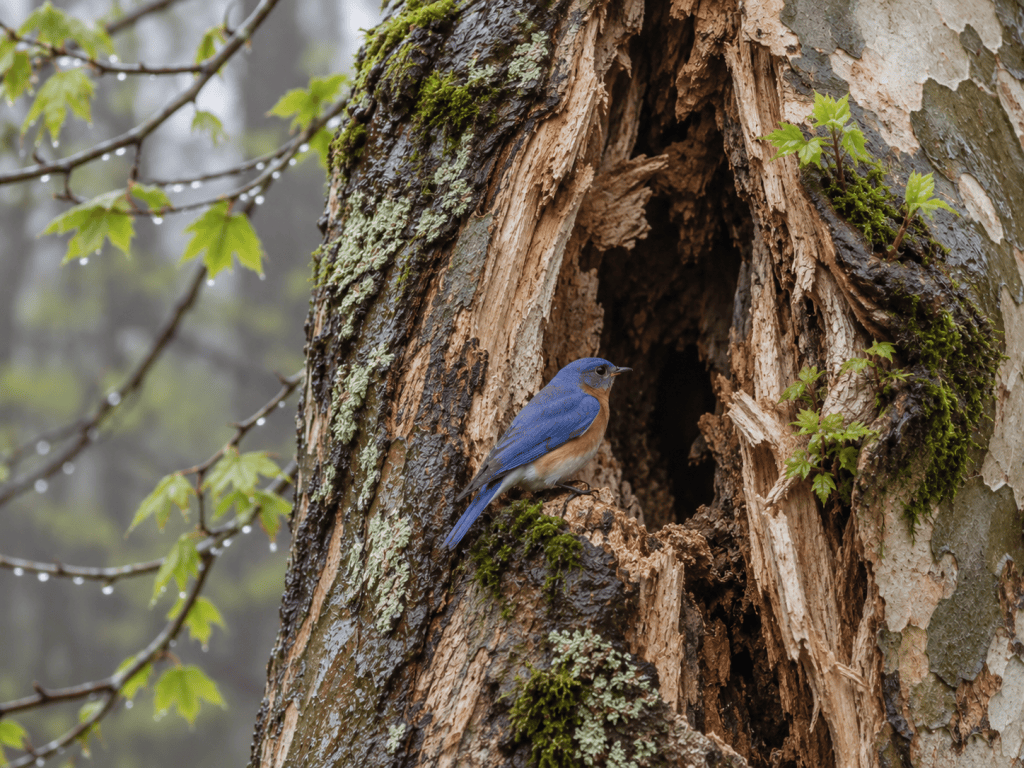
    Above me,
    an Eastern Bluebird
    lands on a broken limb
    with dry grass
    crosswise in her beak.

    She drops to the hollow,
    leans into the dark,
    then backs out
    with the grass still crosswise.

    At the lowest root,
    three wet leaves
    seal a narrow groove.

    I work them loose
    with a sycamore twig.

    Water slips from the hollow,
    brown at first,
    carrying bark
    and one drowned beetle.

    I wait
    until it reaches the mud
    without color.

    The bluebird returns
    with one white feather.

    She grips the new rim,
    looks once
    into the hollow,
    and disappears.

    For a moment,
    her tail remains
    in the sunshine,
    then folds
    into the tree.

    —Iris Lennox

  • Before We Cover the Wound


    In “Before We Cover the Wound,” Iris Lennox restores a wartime letter and confronts what healing requires before a wound can be mended.

    While watching A Private Life (Vie privée), a quirky little French film starring Jodie Foster, I heard a line that made me pause the movie and write it down: “We don’t cover uncleaned wounds here.” Later, I wrote this poem.

    At my oak worktable,
    I turn the letter
    face down.

    A strip of cellophane
    crosses the center fold,
    yellow as weak tea.

    Both ends curl
    away from the paper,
    exhausted and maybe
    a little crabby with age.

    I slide a thin blade
    beneath the upper edge.

    Three paper fibers rise.

    I stop.

    A damp brush
    clouds the hardened glue.

    The tape loosens
    one millimeter at a time,
    leaving a faint brown line.

    Drabby yellow
    and brown.

    Not my aesthetic at all
    but it reminds me
    of a living room from the 1970s
    I used to love.

    Underneath,
    the old tear opens
    from the margin
    through four lines of ink.

    For several minutes,
    the letter lies
    in two pieces.

    I turn both halves
    face up.

    Finally. Blue.

    The letter begins
    Dear Mother,
    and is dated
    January 18, 1945.

    Somewhere in Belgium,
    which is the Army’s name
    for every place
    it would rather not let
    a mother imagine.

    He starts with the weather—
    no one is afraid
    to hear about the weather.

    Snow reaches
    the tops of his boots.

    Coffee freezes
    in a cup.

    He drinks quickly now
    and writes that this
    counts as a promotion
    in his unit.

    Then Eddie appears.

    Yesterday a piece of the war
    found Eddie below the knee.


    One fold of wool
    from his trousers
    is wedged in the wound,
    with enough mud
    to make Belgium
    smaller by one handful.

    My great-uncle cuts
    the cloth away
    with the pocketknife
    he keeps tied
    to his belt.

    He pours water
    from his canteen
    while Eddie calls him
    every name
    he learned in New Jersey.

    When he runs out of names,
    he grips my great-uncle’s sleeve
    and asks him
    to keep going.

    The water carries out
    brown wool,
    a sliver of metal,
    and finally
    only water.

    He opens his field dressing
    and presses the white pad
    over the place
    where Eddie’s leg
    begins again.

    He sleeps now,
    the letter says,
    with one hand closed
    around my sleeve
    .

    Near the bottom,
    my great-uncle adds:

    I love you, Mother.
    There. I wrote it.
    Don’t carry on.


    By sunset,
    the softened glue
    rests in amber crumbs
    beside my wrist.

    A narrow strip
    of mulberry paper
    holds the torn edges
    fiber by fiber.

    The handwriting
    shows through.

    Under the work lamp,
    a thin white seam
    runs through the sentence.

    The ink enters
    on one side
    and continues
    on the other.

    —Iris Lennox