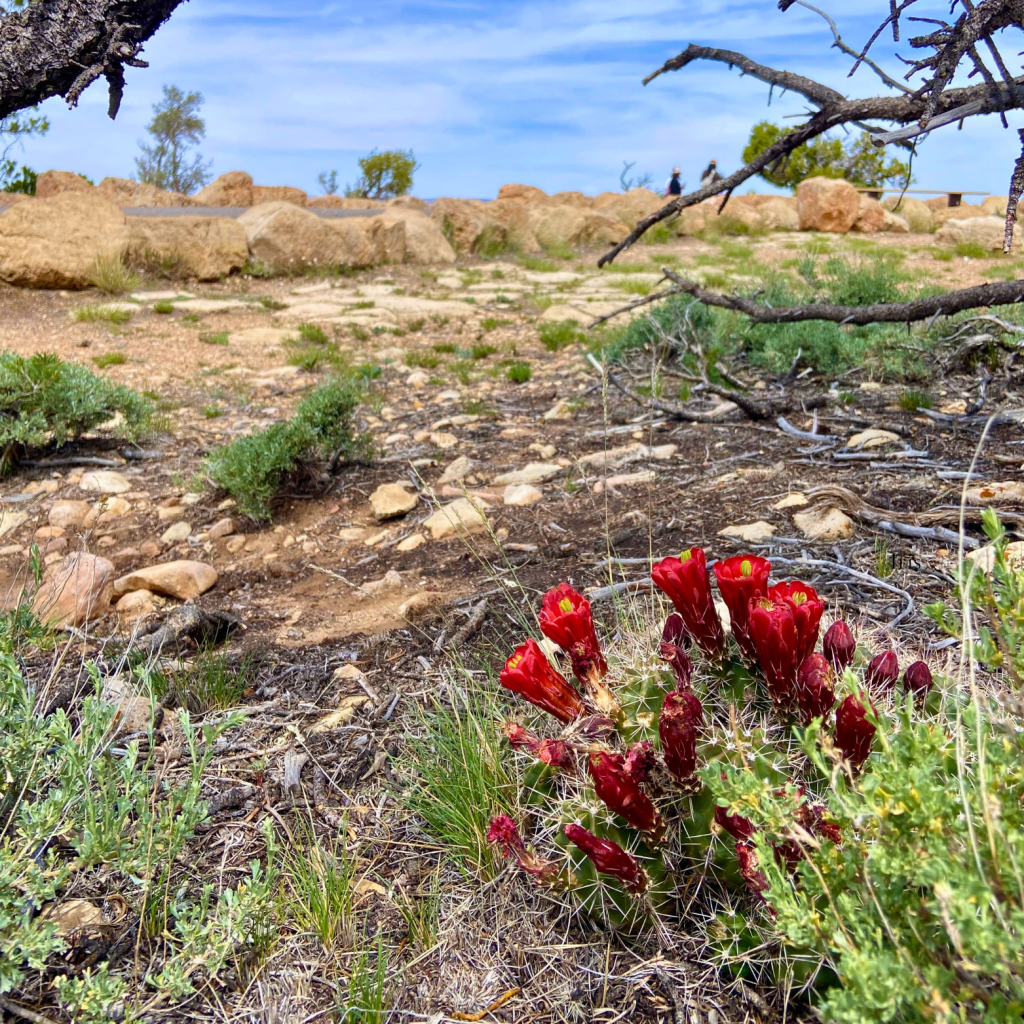
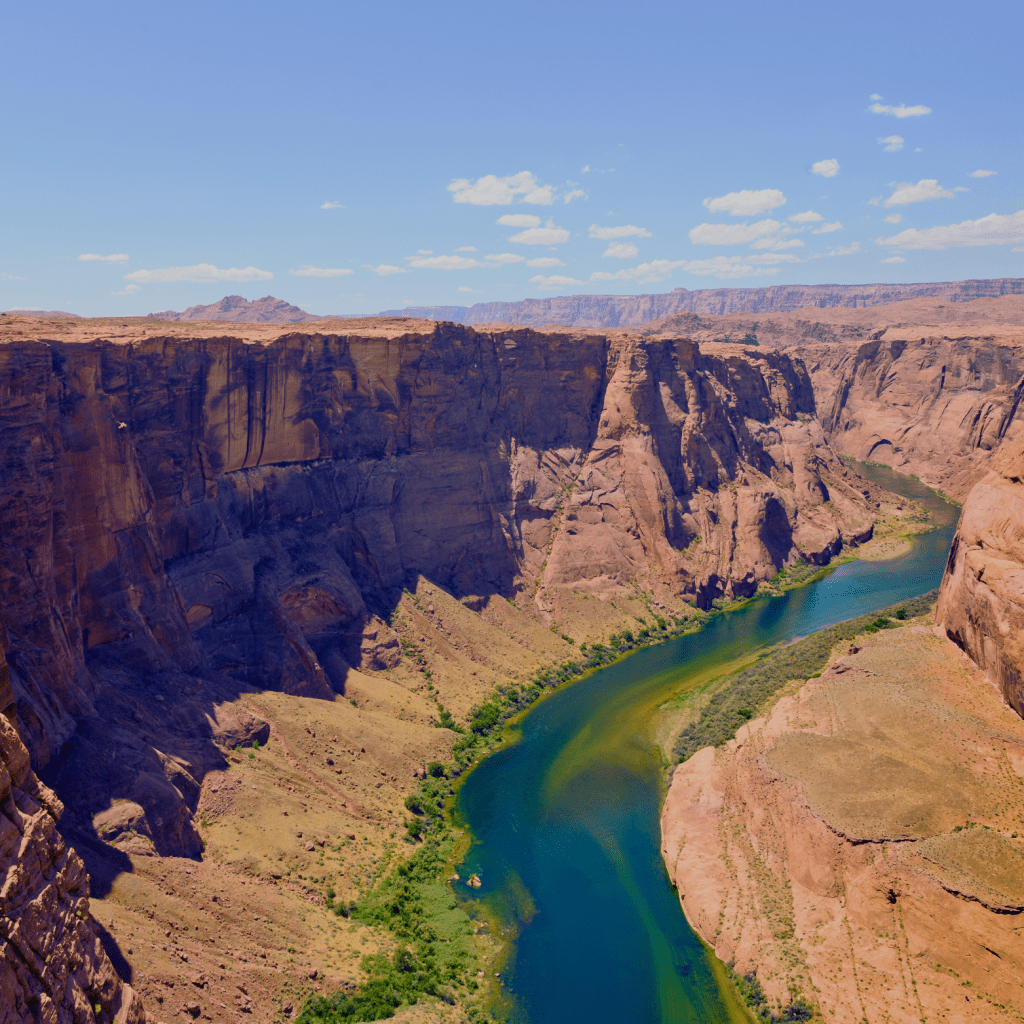
At the rim of the Grand Canyon, Without widening, announcing, or calling the eye— it gathers.
Close to the ground, armed at every point, it holds what little comes— light taken in, water kept, time pressed inward until it thickens.
In the long discipline of it— through heat, through absence, through the steady refusal of the earth to give— a form is made that does not bend outward.
It keeps its boundary.
And then— at the very places of defense— a breaking open.
Not of the structure, but from within it.
Red, rising at the tips, petals pushing through the same points that once kept distance, softness unfurling precisely where sharpness was required.
The form remains— spine, circle, the careful architecture of survival—
and yet, from that same design, another shape appears.
On the surface— color, sudden, plain to the eye.
Beneath— a long keeping, a measure held without witness, without haste.
The cactus carries both at once, dividing nothing, choosing neither.
And we, drawn to what widens, what opens easily to us, pass by— standing at the edge of what is vast, naming that grandeur, and missing what has taken form among the spines.
In the keeping of it, in the exactness of boundary and the timing of its release, God gives:
what holds its form, what keeps its boundary under pressure, without collapse—
and what opens only where it has been formed to open,
until what has been gathered in silence appears, not everywhere, but precisely—
In many stories, we see a man overcoming great odds by wrestling with the weaknesses anchored inside himself, rather than those he must fight in the world around him.
The age-old story of Man vs. Self.
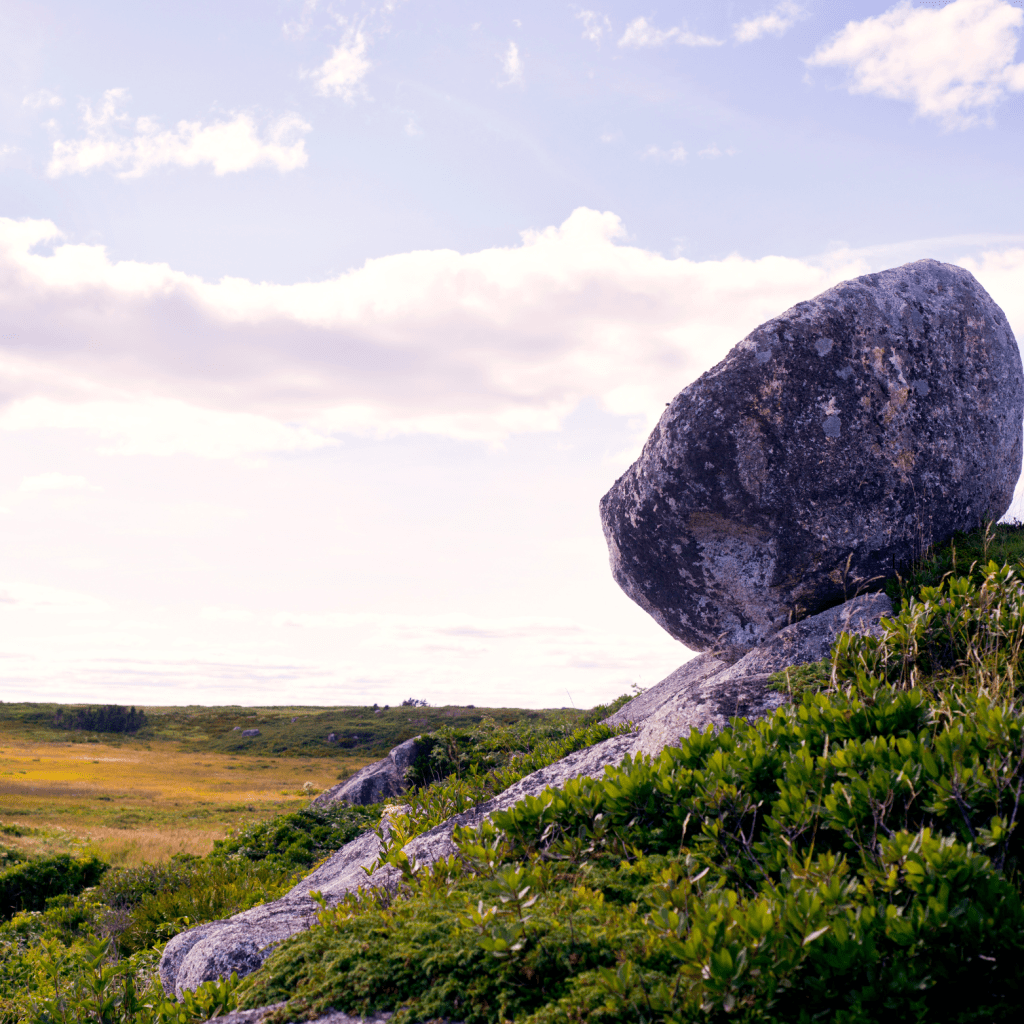
One of the most memorable tragic heroes in Greek mythology is Sisyphus, the prince whose moral foibles Zeus punishes by dooming him to roll a boulder up a hill eternally, the rock rolling back down each time he manages to muscle it to the top.
The first time I heard this story, I was in seventh grade. We read it aloud in English class through timid and cracking voices. I should have known then that I had a serious bent toward the philosophical. The story captured both my imagination and my emotions to such an extent that I immediately felt what I can now identify as empathy for the main character. I wanted to reach beyond the centuries to help Sisyphus.
Because I couldn’t do that, I settled on trying to prove the story wrong.
This was my way of rectifying the deeds of Zeus and the fate of Sisyphus himself. It was also my way of closing the dissonance I felt as I considered the unfairness of the story. How had we, as a human race, allowed this man’s torment to survive in our books, our minds, our cultural imagination for so long?
Clearly, it was up to me to change the narrative.
Once the bell rang for lunch, I donned my invisible cape and set out on a dangerous adventure. Knowing we weren’t allowed on the soccer field unless we were in PE, I slipped past the lunchroom proctor, ducked under the railings, and made my way down the hill that led to the edge of the field. At the far end, the incline rose steeply enough to pass, in my mind, for a mountainside.
My school was called Foothills Junior High. The name was not decorative. It sat at the base of a mountain in Los Angeles. I knew this was the place to right the wrongs set forth by the Greek gods.
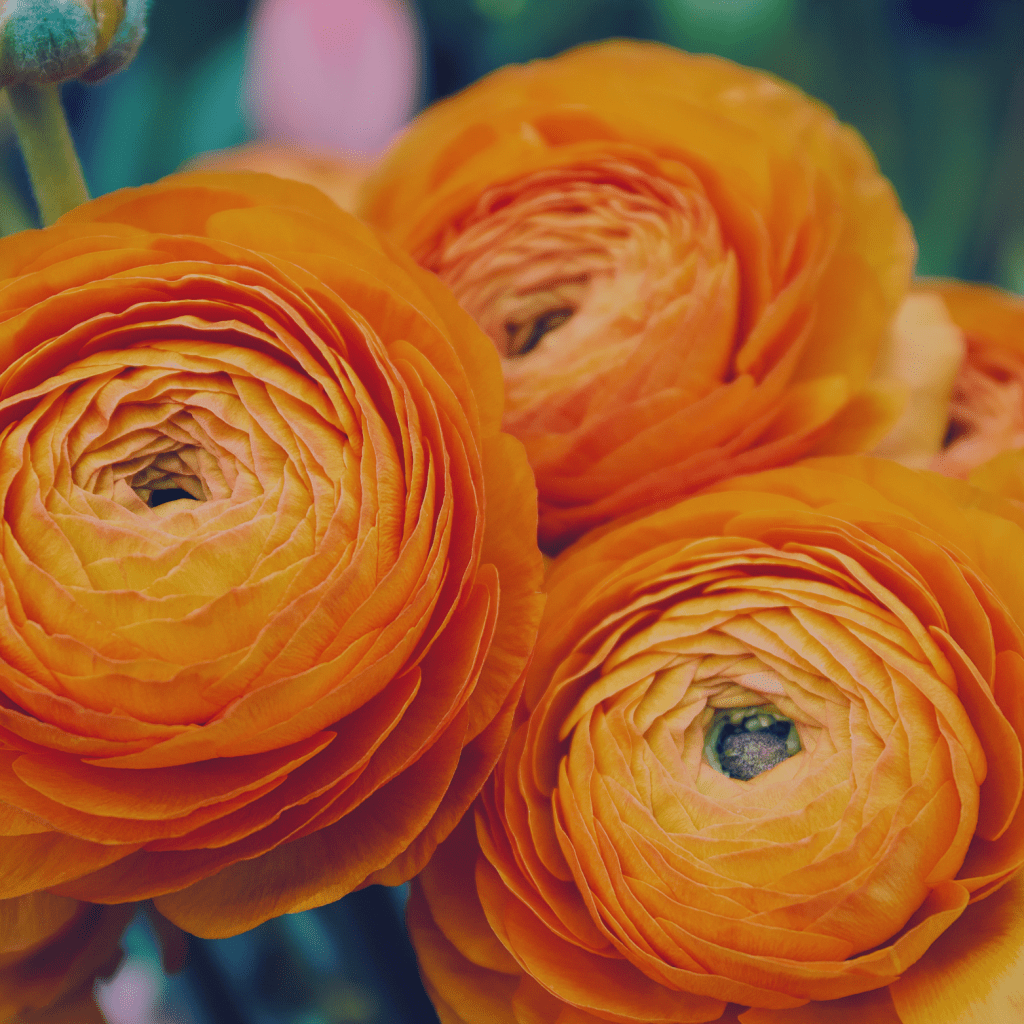
I looked for a rock. I never found one large enough to make the journey feel worthy, but I did find a kickball. Orange, round, just large enough to wedge between my shoulder and neck as I climbed on my hands and knees, pushing it upward with a kind of theatrical conviction that, in retrospect, revealed itself early.
I made it to the top.
My hands were filled with pebbles, my knees ground into denim and dirt. I stood there for a moment, the kickball in my grip, scanning the field beneath the dry California sun. A victory, unmistakable.
And then, unlike Sisyphus, I made a decision.
I would not let the rock roll back down. I would carry it.
Halfway down the hill, I lost my footing.
It happened quickly. Instinct took over. The ball slipped free. I watched it fall.
Disaster.
I tried again.
Three times I made it to the top. Not once did I make it all the way down.
Up the hill. Down the hill. Up again. Down again.
The past returned as the present, and I heard the bell ring for science class.
Maria Popova writes of Sisyphus:
He may be a tragic hero, but he is first and foremost a hero, precisely for this unrelenting faith in the possibility of accomplishing the impossible. His optimistic tenacity renders him the epitome of the creative spirit.
Jack White, in his song Over and Over and Over, gives the story another life:
The Sisyphean dreamer My fibula and femur Hold the weight of the world (Over and over)
The rock ‘n’ roller, the young and older Rolling back to the stroller (Over and over)
One story, carried through different forms, returning again and again.
And then, from Ecclesiastes:
All streams run to the sea, but the sea is not full. To the place where the streams flow, there they flow again.
What has been is what will be, and what has been done is what will be done, and there is nothing new under the sun.
A repetition that feels, at times, unbearable.
Life returns us to the same questions, the same efforts, and the same inclines. We strain, we lose our footing, we begin again. Something in us resists the cycle. Something else learns how to thrive within it.
There is a kind of dignity in that.
Not in escaping the hill, but in meeting it.
Not once, but again.
And again.
So I think of that hillside near the soccer field.
Of the orange ball slipping from my hands.
Of the certainty I had that I could change the ending.
The morning sun draws itself in lines across my hand as I lift the shades. Three succulents on the sill squint and awaken.
I fill the kettle with filtered water, set it on the stove, and wait as heat gathers, quietly like the introduction of a song before the singing begins.
I scoop the grounds into the press— piñon nut coffee from New Mexico, dark, resinous, faintly sweet, holding desert sun in its edges.
The water stirs before it speaks. I watch the surface tremble, then rise into a low, certain boil.
At the window, my black cat claims his post. A squirrel meets him there, small hands braced against the glass. They study each other as if to ask, "Oh, just you? Again?"
In the living room, my white cat stretches long across the rug, pressing herself into the day. A small felt cat rests beside her— a careful replica, stitched into stillness.
The kettle calls me back. I pour.
Water meets grounds, and the air deepens— coffee blooms, expands, releases what it has carried.
I stir once, twice, set the lid, and press the timer: four and a half minutes.
I lean into the counter where the sun has already shifted.
Steam lifts from the press, moves through the room beckoning even the walls to wake.
The squirrel disappears. My black cat stays, newly enthralled by a robin hopping through grass.
My white cat settles beside her smaller self. They rest in the same light, one breathing, one not.
The timer sounds. I press the plunger down, slow, steady, feel the quiet resistance give way— a practice in patience amid anticipation.
I pour the coffee. I lift the cup. I take the first sip.
Another morning where God makes morning and succulents and sunlight and cats,
Ask the old ones. Not for stories— for dates, distances, what came first and what followed.
Has anything like this happened before?
A people hearing a voice from the middle of fire and continuing to breathe after the sentence ended.
Fire does one thing well. It finishes what it starts.
Yet there they stood, faces lit from below, listening to licks and flares carry meaning without turning kindling to ash.
Or this—
a nation taken out of another nation, not quietly, but with signs that carved faces and covered the sun, by a hand that did not hide itself, with a kind of persistence that left artifacts in places and on the skeletons that witnessed it.
Ask Egypt, if ruins could answer.
Ask the sea, which briefly agreed to try on the accoutrements of land and then returned to its original fashion.
They were shown these things so they would know— this is how the account records it.
Not suspect. Not wonder.
Know that the voice was not one among many, not a possibility, a debate between equally convincing objections.
Above, below— no second version waits to be discovered later.
This is the claim as it has been carried forward.
So they are told to keep it.
Not out of fear, though fear was present. Not out of habit, though habit will come.
Keep it so that when their children ask what happened in those days, they will not offer a softened account.
Tell them they heard something that should have undone them and did not.
Tell them they walked through what closed behind them.
The builders understand the angles— how weight settles into a beam, how a line must lean before it can stand.
They take the time to dream, to envision, to let something unfinished sit beside them like a quiet companion.
In the late hours, when the world settles into dew and the last light leaves the window, they see it— not yet formed, but certain enough to return to.
They move toward it slowly.
Hands learning the material— the first press too hard, the surface pushing back, then giving slightly under the thumb.
There is a patience to it— a willingness to begin again without pretending that nothing failed along the way.
And when it sits just right in the place where positive and negative space hold one another— where the weight rests without shifting,
when something rises that did not exist before,
they step back grateful to recognize it—
not as completion, but as process and maybe cohesion.
Something new to sit beside. Something to enter.
Those who tear down move in starts.
They do not linger in spaces where people or places or ideas are becoming.
They look for structures already standing and rest their heads against pillars—cracked, flaking at the edges— trusting what still holds to hold for them.
Their attention sharpens there— at the point where structure meets strain, where something held together might give way— a thumb pressed once at the weakened place.
They have no questions— not how it was made, not why.
They do not stay long enough to understand what it required to stand at all.
Instead, they borrow from what surrounds them— picking up a word already spoken, wearing it as if their name were stitched inside,
and hold it just long enough for the next voice to take its place.
They wait for the world to hand them a reflection they can accept without question.
And while they wait,
they pull—
at the edge, where the fabric thins, at the seam where threads begin to separate,
at the place where something is most alive and therefore most vulnerable.
It does not take long.
What took time to imagine, to hold, to bring into form—
can be undone in a moment— a shift, a break in tension— and it gives.
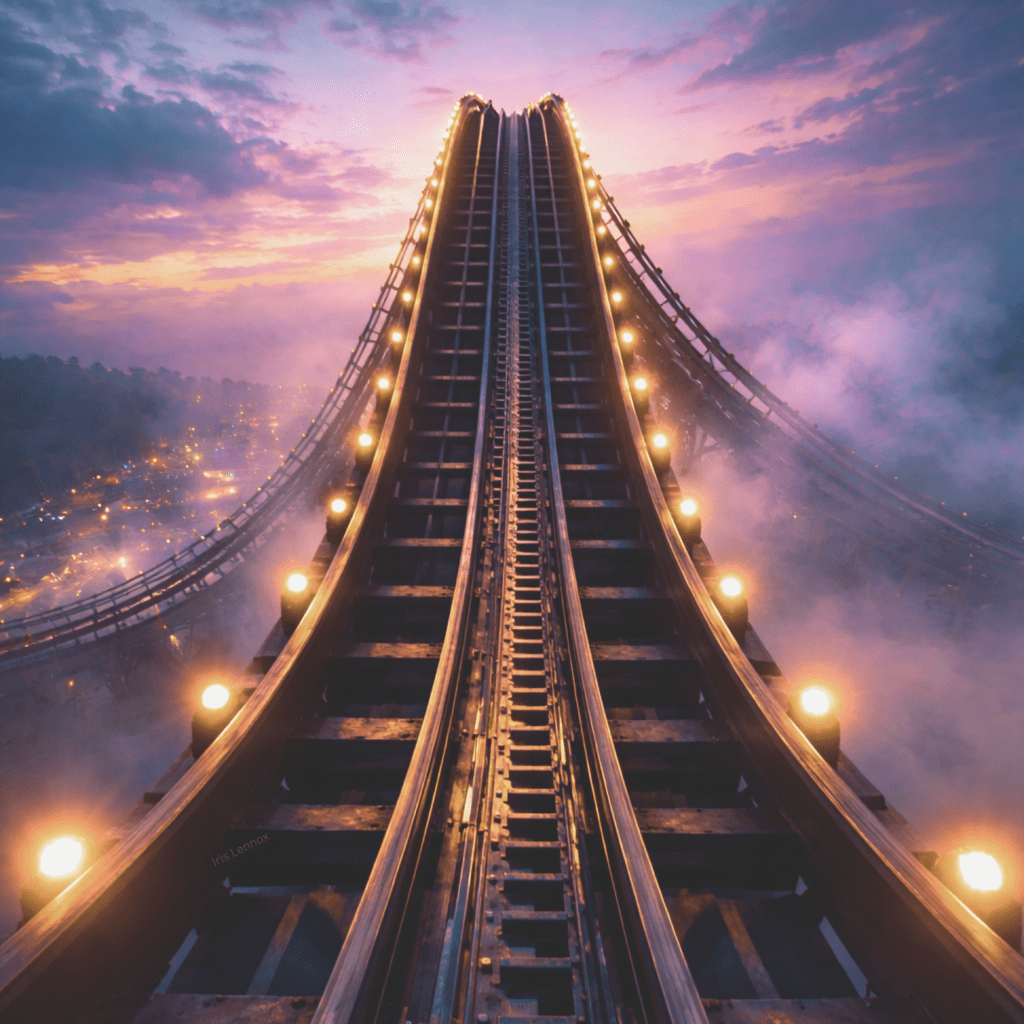
Music wafting through the air or is that birds or Tinkerbell? I got some dust inside my eyes so it must be the fairy swooshing by.
Marching bands with brass and bass kings and princesses take their place to tell the story— the same one again: a far away land a witch and a hand given in fanfare to a sashed, bare-faced man.
There are rides to be taken heroes who capture and race down adrenaline-filled paths that feel like lov— no, rapture.
Slow and then fast through dazzling light enough to fly past the machine in the back and the character smoking with his head hung on a rack—
We agree not to see.
Lights flicker gold and then blue wait—did he just look or did he look through? A pause in the motion something like timing I take as a cue.
Confetti drifts ash, or snow touches my sleeve then lets me go I leave it there— a moment too long part of the set and now so am I
—and who am I?
I forget.
Voices echo layered thin— his or theirs or somewhere between I turn to see then let it be what it was I could have sworn the words pointed to you.
The track tilts— just slightly off enough to blame on atmosphere or thought I steady once then sit up again and see the path has gently bent
not back not through—
just near
A mirror placed at child-height glass returns a face I almost pass until it lingers half a beat—
more sure of you than it is of me
A worker sweeps the same small spot back and forth as if it’s not already clean already done—
I watch too long then call it one of those things that people repeat to keep the edges soft and the picture neat.
A door marked STAFF stands open wide no one there but light inside. I look—
then don’t—
then walk beyond
back into sound and colored air where something waits that isn’t there or isn’t mine— but knows my name well enough to feel the same
The music swells— or something like it close enough that I don’t fight it I take my place without a claim
Surrounded by air and invisible strings attaching to all corners of the universe, there lies a star in the sky. The star’s name is Vincent, his moniker bearing the stamp of the famous painter on Earth to whom his mother was introduced when one of his paintings was lost in space and drifted across her gaze.
Vincent is lazy, and his breath is a series of inhalations and exhalations shaped by boredom. He has learned not to expect entertainment from his fellow floating orbs. The splendor of their illumination is juxtaposed by their inability to sing or dance or, in any way, delight his fancy. They lie scattered across the galaxy, telling stories about the things they’ve never done, the places they’ve never been, and the memories they’ve never actually made.
The sky is not liquid, but it is still. Except when comets come screaming past their stuck counterparts, or when a star burns out and drifts away, movement is not allowed. Change rarely occurs. Vincent is fixed in a fixed state, and he has given in to the stuckness of his existence.
Vivienne is newer. Relatively new. She has not yet lost the fervor of her “what if” and dreams of destinations beyond the darkness and points of light by which she is surrounded. Vivienne is vivacious and full of wonder. Her curves have not yet been chipped away by the chisels of time or NASA’s rumbling past her looser rocks. She is intelligent, bright, an artist at her core who does not spend time lamenting her lack of limbs. Instead, she fills the sky with her songs and laughter and tells stories born in the dreams she has when she closes her eyes to sleep.
One day, a spacecraft flown by human hands nicked the side of Vincent’s ribs. It was clearly an unintended greeting, and it caused Vincent a lazy amount of consternation.
“The NASAs don’t understand space, am I right?” he dribbled out sarcastically as his body reacted to the impact, shifting ever so slightly to the right.
As his roundness rotated by infinitesimal degrees, Vincent suddenly saw a new perspective. The view he had held for centuries had been just slightly off to the left. As his eyes adjusted, he whispered into the darkness, “What the—”
Newness.
Vincent shook his head and closed his eyes. Then he opened them again, trying to adjust his vision. A bit near-sighted, he had to refocus once more. When his eyes opened the second time, his heart filled with wonder. He could see stars he had never seen before. A draft brushed against his back in an unfamiliar way. The stars newly visible to him were sleeping, ignoring the NASA that had just shifted his perspective.
One of the stars he had never seen before was snoring.
As Vincent would later learn, the snoring star’s name is Dick. Dick, known as Richard to those with whom he is not well acquainted, wears a smoking jacket and smokes a pipe in his mind. He pontificates on matters such as the romantic lives of the earliest stars and prides himself on knowing intimate details about the moons surrounding each of the planets.
For centuries, a rumor circulated that Dick once sent notes of love and longing to Europa. Europa, one of Jupiter’s moons, has a voice like a hushed flute, high, soft, arresting. Dick’s love notes were legendary, poetic, stirring a romance so engaging that hardly any stars within several light-years slept during the centuries of their affair.
Until Europa broke his heart by falling in love with another of Jupiter’s moons, Ganymede. Since then, Europa and Ganymede have whispered to one another, keeping their romance private. Ganymede is not nearly as showy a suitor as Dick.
And so, the sky lost its drama. It returned to the mundane: blackness, occasional pirate songs, the same stories told to the same stars, over and over again. The order of the sky began to resemble the Moose Lodge from The Flintstones, the same people, the same stories, the same faces.
Until the gods allowed a NASA to nick Vincent’s side.
That small disruption sparked the possibility of new sightlines, new encounters with stars whose old stories would be new to him. When two personalities meet for the first time, it is not only their lives that shift. Those around them feel it too. Energy renews. Sometimes for the better. Sometimes not. Always for the new.
Vincent widened his eyes and took it in: the lighter shade of black in the upper right corner of his vision, the way surrounding light now touched the edges of his face, the unfamiliar stars whose voices he had heard but never seen.
A sense of wonder filled his old heart. Something stirred inside him. It sounded like a triangle tapped lightly, like Tibetan bells ringing, like a finger drawn slowly across the surface of a gong. A deep, peaceful awareness of life, and his aliveness.
Vivienne yawned, long and breathy, and opened her eyes as a NASA sped past her head. She blinked once. Then again.
And in that second blink, she became aware of two eyes she had never seen before.
They were looking back at her.
She blinked again.
Vincent wanted to speak, but instead, he blinked too. Four blinking eyes, fanning something into flame. A steady fire.
From that moment until now, Vincent and Vivienne hang on opposite ends of the sky. They do not speak. They do not sing. They do not send notes on the backs of passing NASAs.
They hang, separately, gently, precariously, held by invisible strings attached to all corners of the universe.
And they blink.
And open.
And blink.
And open.
They cannot move toward one another. They will never touch the surface of each other’s being. Even so, they remain connected, by the turning of Vincent’s perspective and by the quiet recognition that passed between them.