In “Before We Cover the Wound,” Iris Lennox restores a wartime letter and confronts what healing requires before a wound can be mended.
While watching A Private Life (Vie privée), a quirky little French film starring Jodie Foster, I heard a line that made me pause the movie and write it down: “We don’t cover uncleaned wounds here.” Later, I wrote this poem.
At my oak worktable, I turn the letter face down.
A strip of cellophane crosses the center fold, yellow as weak tea.
Both ends curl away from the paper, exhausted and maybe a little crabby with age.
I slide a thin blade beneath the upper edge.
Three paper fibers rise.
I stop.
A damp brush clouds the hardened glue.
The tape loosens one millimeter at a time, leaving a faint brown line.
Drabby yellow and brown.
Not my aesthetic at all but it reminds me of a living room from the 1970s I used to love.
Underneath, the old tear opens from the margin through four lines of ink.
For several minutes, the letter lies in two pieces.
I turn both halves face up.
Finally. Blue.
The letter begins Dear Mother, and is dated January 18, 1945.
Somewhere in Belgium, which is the Army’s name for every place it would rather not let a mother imagine.
He starts with the weather— no one is afraid to hear about the weather.
Snow reaches the tops of his boots.
Coffee freezes in a cup.
He drinks quickly now and writes that this counts as a promotion in his unit.
Then Eddie appears.
Yesterday a piece of the war found Eddie below the knee.
One fold of wool from his trousers is wedged in the wound, with enough mud to make Belgium smaller by one handful.
My great-uncle cuts the cloth away with the pocketknife he keeps tied to his belt.
He pours water from his canteen while Eddie calls him every name he learned in New Jersey.
When he runs out of names, he grips my great-uncle’s sleeve and asks him to keep going.
The water carries out brown wool, a sliver of metal, and finally only water.
He opens his field dressing and presses the white pad over the place where Eddie’s leg begins again.
He sleeps now, the letter says, with one hand closed around my sleeve.
Near the bottom, my great-uncle adds:
I love you, Mother. There. I wrote it. Don’t carry on.
By sunset, the softened glue rests in amber crumbs beside my wrist.
A narrow strip of mulberry paper holds the torn edges fiber by fiber.
The handwriting shows through.
Under the work lamp, a thin white seam runs through the sentence.
The ink enters on one side and continues on the other.
Once home to more than two thousand people, Times Beach, Missouri, is now part of Route 66 State Park, its former streets winding through grass, wetlands, and trees.
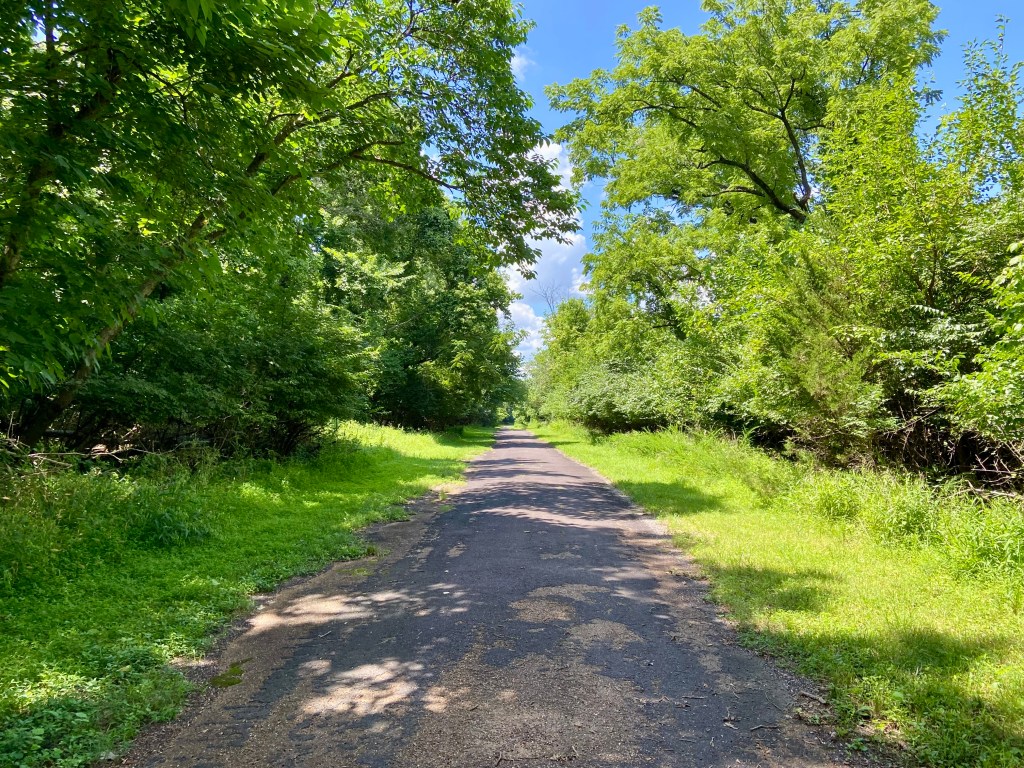
Grass grows high along the path,
seed heads bending in the July heat.
Cottonwoods lift their silver leaves
and turn them over in the wind.

Somewhere beyond the trees,
the Meramec moves brown and slow.
Cicadas start and stop.
A turkey disappears into the sumac,
leaving one branch shaking behind her.

I walk where the path bends gently,
following its long, deliberate curve
through Queen Anne's lace and clover.

For years, I've assumed the curve was shaped by the land.

I think the trees have drawn it there,
that roots and rain have persuaded the path
to turn a little to the left.

But the curve was here before the trees.

This was a street.

The slightly hidden marsh beside me
had an address.
There were mailboxes here,
porch steps, garden hoses,
bicycles dropped in yards at dinner time.

A woman shakes a white sheet in the sun.
A screen door strikes its frame.
Someone calls a child home
before dusk makes the river invisible.

I hear no names being called.

Still, I stand in the middle of the old road
while cicadas stitch their noise through the trees,
and for a moment the grass seems crowded.

They sprayed the roads with oil
to keep the dust from rising.

The streets were unpaved then.
Cars sent the dry earth climbing
into open windows and onto porches,
over laundry, into kitchens,
into the mouths of children playing outside.

So they paid a man to settle it.

He came with a truck
and spread oil over the roads,
darkening the dust,
pressing it back into the earth.

Such a small sentence:

to keep the dust down.

To keep it from settling on windowsills,
on supper plates,
on the faded blue jeans drying in the sun.

The road kept what it was given,
accustomed to service.

Eleven summers pass.
Children ride bicycles over it.
Rain darkens it.
The sun warms it.
Women open their windows in April.

Then the river rises.

It enters the houses without knocking,
climbs the stairs,
lifts chairs from kitchen floors,
pulls photographs from drawers.

And when the water folds back
into its comfortable rhythm,
it leaves the secret in the mud.

I walk here now
with sunlight brushing across my shoulders.

No houses.
No mailboxes.
No white sheets rising in the wind.

Only the wetland,
the mound,
the old roads curving through the trees.

They burned the poisoned earth eventually,
two hundred and sixty-five thousand tons of it,
and buried what remained beneath the grass.

I've walked the hill where fragments of a town
turn slowly in the earth—

a blue cup without its handle,
one white button,
the rusted hinge of a closet door,
a marble lost beneath a child's bed,
the broken mouth of a jar
that once held peaches.

Things someone touched every day
without knowing there would come a day
when no one touched them again.

Now coneflowers open in the sun.
Frogs call from the water.
A red-winged blackbird bends a reed
almost to the ground.

I have walked here for three years
without knowing what was under my feet.

The streets, trails.
The mound, a hill.

I watched deer step out at dusk
where someone's back door used to be.

Today I stop beside the tall grass.

The wind passes over it
and every green blade leans
in the same direction.

Then rises.

Then leans again.

As if the earth is trying
to remember a name.

—Iris Lennox


If you'd like to know more about the town beneath these trails, I wrote about the strange history of Times Beach and its second life as Route 66 State Park here.
Surrounded by air and invisible strings attaching to all corners of the universe, there lies a star in the sky. The star’s name is Vincent, his moniker bearing the stamp of the famous painter on Earth to whom his mother was introduced when one of his paintings was lost in space and drifted across her gaze.
Vincent is lazy, and his breath is a series of inhalations and exhalations shaped by boredom. He has learned not to expect entertainment from his fellow floating orbs. The splendor of their illumination is juxtaposed by their inability to sing or dance or, in any way, delight his fancy. They lie scattered across the galaxy, telling stories about the things they’ve never done, the places they’ve never been, and the memories they’ve never actually made.
The sky is not liquid, but it is still. Except when comets come screaming past their stuck counterparts, or when a star burns out and drifts away, movement is not allowed. Change rarely occurs. Vincent is fixed in a fixed state, and he has given in to the stuckness of his existence.
Vivienne is newer. Relatively new. She has not yet lost the fervor of her “what if” and dreams of destinations beyond the darkness and points of light by which she is surrounded. Vivienne is vivacious and full of wonder. Her curves have not yet been chipped away by the chisels of time or NASA’s rumbling past her looser rocks. She is intelligent, bright, an artist at her core who does not spend time lamenting her lack of limbs. Instead, she fills the sky with her songs and laughter and tells stories born in the dreams she has when she closes her eyes to sleep.
One day, a spacecraft flown by human hands nicked the side of Vincent’s ribs. It was clearly an unintended greeting, and it caused Vincent a lazy amount of consternation.
“The NASAs don’t understand space, am I right?” he dribbled out sarcastically as his body reacted to the impact, shifting ever so slightly to the right.
As his roundness rotated by infinitesimal degrees, Vincent suddenly saw a new perspective. The view he had held for centuries had been just slightly off to the left. As his eyes adjusted, he whispered into the darkness, “What the—”
Newness.
Vincent shook his head and closed his eyes. Then he opened them again, trying to adjust his vision. A bit near-sighted, he had to refocus once more. When his eyes opened the second time, his heart filled with wonder. He could see stars he had never seen before. A draft brushed against his back in an unfamiliar way. The stars newly visible to him were sleeping, ignoring the NASA that had just shifted his perspective.
One of the stars he had never seen before was snoring.
As Vincent would later learn, the snoring star’s name is Dick. Dick, known as Richard to those with whom he is not well acquainted, wears a smoking jacket and smokes a pipe in his mind. He pontificates on matters such as the romantic lives of the earliest stars and prides himself on knowing intimate details about the moons surrounding each of the planets.
For centuries, a rumor circulated that Dick once sent notes of love and longing to Europa. Europa, one of Jupiter’s moons, has a voice like a hushed flute, high, soft, arresting. Dick’s love notes were legendary, poetic, stirring a romance so engaging that hardly any stars within several light-years slept during the centuries of their affair.
Until Europa broke his heart by falling in love with another of Jupiter’s moons, Ganymede. Since then, Europa and Ganymede have whispered to one another, keeping their romance private. Ganymede is not nearly as showy a suitor as Dick.
And so, the sky lost its drama. It returned to the mundane: blackness, occasional pirate songs, the same stories told to the same stars, over and over again. The order of the sky began to resemble the Moose Lodge from The Flintstones, the same people, the same stories, the same faces.
Until the gods allowed a NASA to nick Vincent’s side.
That small disruption sparked the possibility of new sightlines, new encounters with stars whose old stories would be new to him. When two personalities meet for the first time, it is not only their lives that shift. Those around them feel it too. Energy renews. Sometimes for the better. Sometimes not. Always for the new.
Vincent widened his eyes and took it in: the lighter shade of black in the upper right corner of his vision, the way surrounding light now touched the edges of his face, the unfamiliar stars whose voices he had heard but never seen.
A sense of wonder filled his old heart. Something stirred inside him. It sounded like a triangle tapped lightly, like Tibetan bells ringing, like a finger drawn slowly across the surface of a gong. A deep, peaceful awareness of life, and his aliveness.
Vivienne yawned, long and breathy, and opened her eyes as a NASA sped past her head. She blinked once. Then again.
And in that second blink, she became aware of two eyes she had never seen before.
They were looking back at her.
She blinked again.
Vincent wanted to speak, but instead, he blinked too. Four blinking eyes, fanning something into flame. A steady fire.
From that moment until now, Vincent and Vivienne hang on opposite ends of the sky. They do not speak. They do not sing. They do not send notes on the backs of passing NASAs.
They hang, separately, gently, precariously, held by invisible strings attached to all corners of the universe.
And they blink.
And open.
And blink.
And open.
They cannot move toward one another. They will never touch the surface of each other’s being. Even so, they remain connected, by the turning of Vincent’s perspective and by the quiet recognition that passed between them.