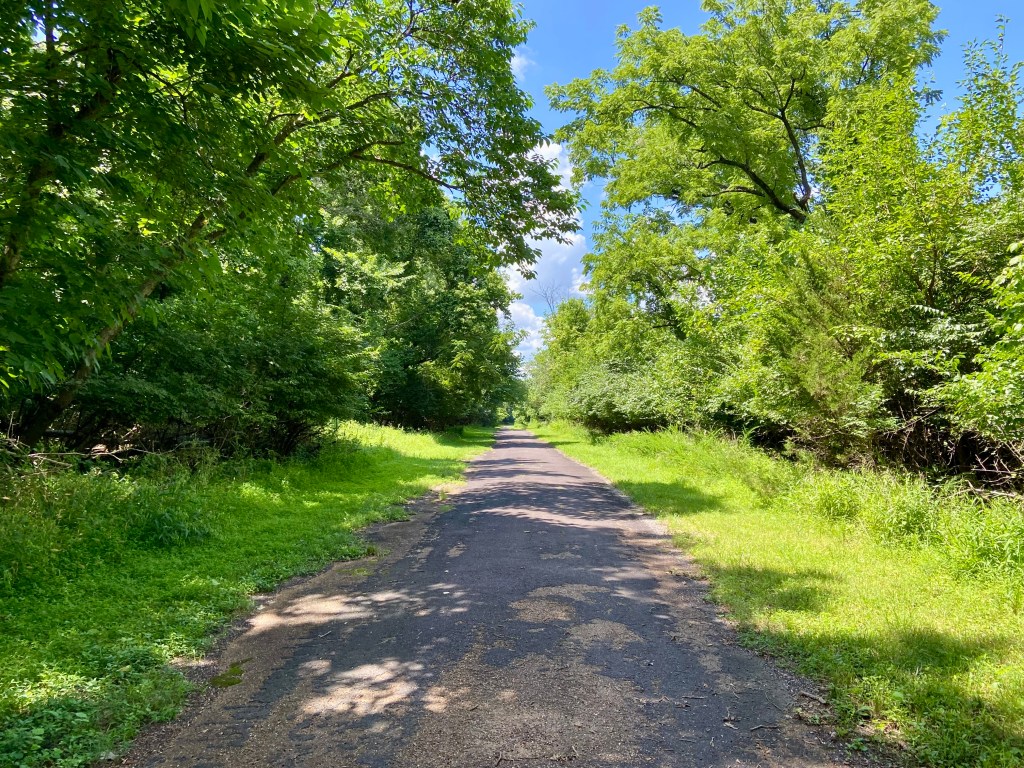
Once home to more than two thousand people, Times Beach, Missouri, is now part of Route 66 State Park, its former streets winding through grass, wetlands, and trees.
Grass grows high along the path,
seed heads bending in the July heat.
Cottonwoods lift their silver leaves
and turn them over in the wind.

Somewhere beyond the trees,
the Meramec moves brown and slow.
Cicadas start and stop.
A turkey disappears into the sumac,
leaving one branch shaking behind her.

I walk where the path bends gently,
following its long, deliberate curve
through Queen Anne's lace and clover.

For years, I've assumed the curve was shaped by the land.

I think the trees have drawn it there,
that roots and rain have persuaded the path
to turn a little to the left.

But the curve was here before the trees.

This was a street.

The slightly hidden marsh beside me
had an address.
There were mailboxes here,
porch steps, garden hoses,
bicycles dropped in yards at dinner time.

A woman shakes a white sheet in the sun.
A screen door strikes its frame.
Someone calls a child home
before dusk makes the river invisible.

I hear no names being called.

Still, I stand in the middle of the old road
while cicadas stitch their noise through the trees,
and for a moment the grass seems crowded.

They sprayed the roads with oil
to keep the dust from rising.

The streets were unpaved then.
Cars sent the dry earth climbing
into open windows and onto porches,
over laundry, into kitchens,
into the mouths of children playing outside.

So they paid a man to settle it.

He came with a truck
and spread oil over the roads,
darkening the dust,
pressing it back into the earth.

Such a small sentence:

to keep the dust down.

To keep it from settling on windowsills,
on supper plates,
on the faded blue jeans drying in the sun.

The road kept what it was given,
accustomed to service.

Eleven summers pass.
Children ride bicycles over it.
Rain darkens it.
The sun warms it.
Women open their windows in April.

Then the river rises.

It enters the houses without knocking,
climbs the stairs,
lifts chairs from kitchen floors,
pulls photographs from drawers.

And when the water folds back
into its comfortable rhythm,
it leaves the secret in the mud.

I walk here now
with sunlight brushing across my shoulders.

No houses.
No mailboxes.
No white sheets rising in the wind.

Only the wetland,
the mound,
the old roads curving through the trees.

They burned the poisoned earth eventually,
two hundred and sixty-five thousand tons of it,
and buried what remained beneath the grass.

I've walked the hill where fragments of a town
turn slowly in the earth—

a blue cup without its handle,
one white button,
the rusted hinge of a closet door,
a marble lost beneath a child's bed,
the broken mouth of a jar
that once held peaches.

Things someone touched every day
without knowing there would come a day
when no one touched them again.

Now coneflowers open in the sun.
Frogs call from the water.
A red-winged blackbird bends a reed
almost to the ground.

I have walked here for three years
without knowing what was under my feet.

The streets, trails.
The mound, a hill.

I watched deer step out at dusk
where someone's back door used to be.

Today I stop beside the tall grass.

The wind passes over it
and every green blade leans
in the same direction.

Then rises.

Then leans again.

As if the earth is trying
to remember a name.

—Iris Lennox


If you'd like to know more about the town beneath these trails, I wrote about the strange history of Times Beach and its second life as Route 66 State Park here.