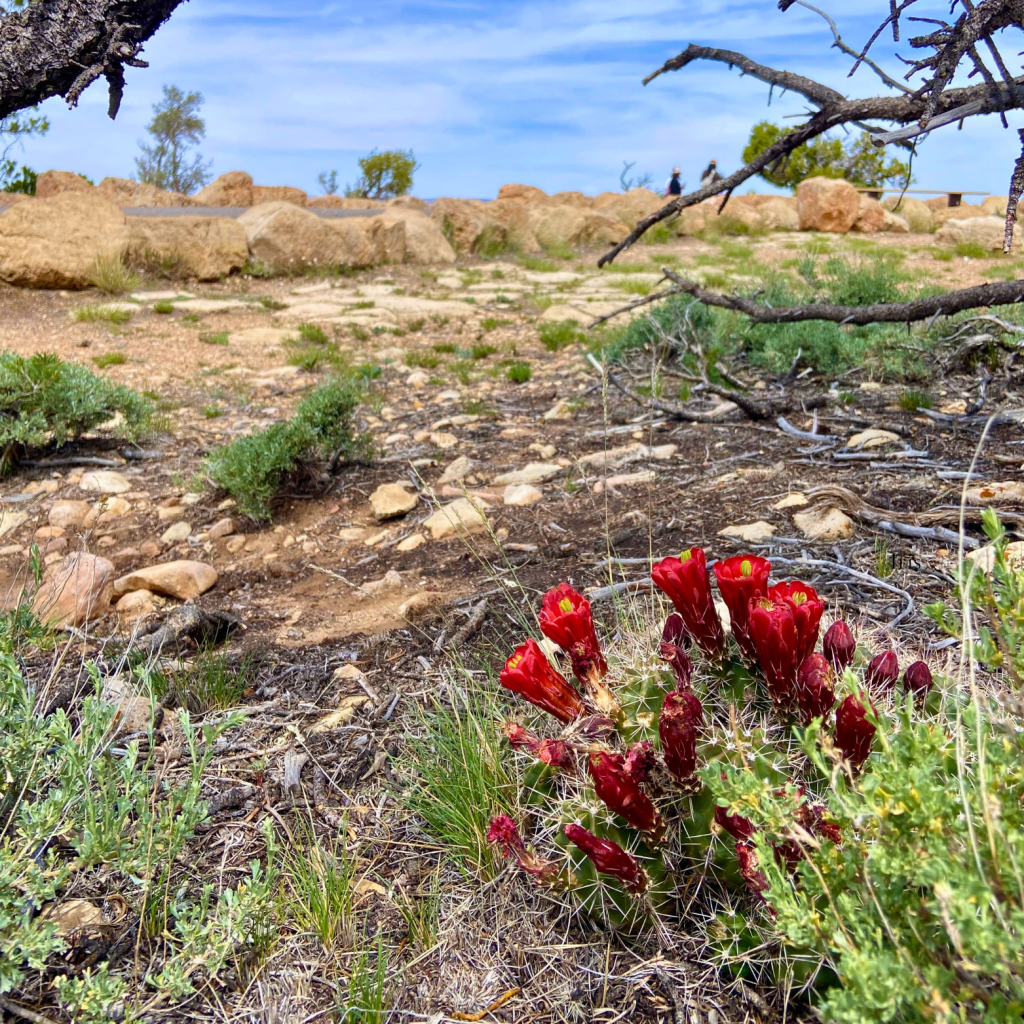
At the rim of the Grand Canyon, Without widening, announcing, or calling the eye— it gathers.
Close to the ground, armed at every point, it holds what little comes— light taken in, water kept, time pressed inward until it thickens.
In the long discipline of it— through heat, through absence, through the steady refusal of the earth to give— a form is made that does not bend outward.
It keeps its boundary.
And then— at the very places of defense— a breaking open.
Not of the structure, but from within it.
Red, rising at the tips, petals pushing through the same points that once kept distance, softness unfurling precisely where sharpness was required.
The form remains— spine, circle, the careful architecture of survival—
and yet, from that same design, another shape appears.
On the surface— color, sudden, plain to the eye.
Beneath— a long keeping, a measure held without witness, without haste.
The cactus carries both at once, dividing nothing, choosing neither.
And we, drawn to what widens, what opens easily to us, pass by— standing at the edge of what is vast, naming that grandeur, and missing what has taken form among the spines.
In the keeping of it, in the exactness of boundary and the timing of its release, God gives:
what holds its form, what keeps its boundary under pressure, without collapse—
and what opens only where it has been formed to open,
until what has been gathered in silence appears, not everywhere, but precisely—