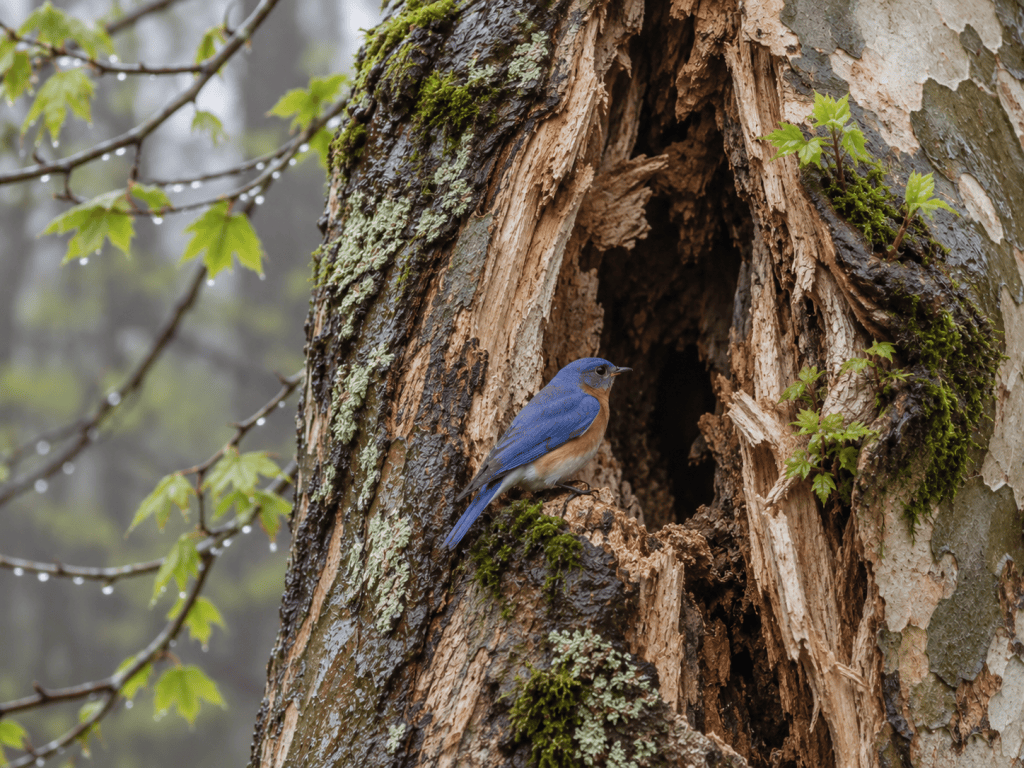
At the bend
below the footbridge,
I stop beside a sycamore
split from its lowest branch
to the roots.
Last week’s rain
fills the long hollow
with water rippling
like stained glass.
A drop gathers
near the upper notch,
runs down the exposed wood,
and carries a thread of yellow dust
to the ground.
Three carpenter ants
move along the rim.
Each enters the dark
and returns
with a pale shaving
held in its jaws.
I assume those are jaws.
I lean close enough
to smell wet bark,
mushrooms,
the iron-colored mud
beneath my boots.
Along both sides
of the opening,
new bark curls inward.
I count six ridges,
each one narrower
than my thumb.
The outermost fold
is green beneath the gray.
A fresh crack
divides its lower edge.
Clear sap gathers there
and stretches
from my fingernail
when I touch it.
For a moment,
I am part of the tree.
The next moment,
my forefinger and thumb
cannot escape one another.
Above me,
an Eastern Bluebird
lands on a broken limb
with dry grass
crosswise in her beak.
She drops to the hollow,
leans into the dark,
then backs out
with the grass still crosswise.
At the lowest root,
three wet leaves
seal a narrow groove.
I work them loose
with a sycamore twig.
Water slips from the hollow,
brown at first,
carrying bark
and one drowned beetle.
I wait
until it reaches the mud
without color.
The bluebird returns
with one white feather.
She grips the new rim,
looks once
into the hollow,
and disappears.
For a moment,
her tail remains
in the sunshine,
then folds
into the tree.
—Iris Lennox

